FX at a glance
- AUD/USD 0.7009 → 0.6957 · 1 week -0.74% · 1 month -3.39%
- USD/KRW 1,354.45 → 1,343.34 · 1 week -0.82% · 1 month -0.89%
- AUD/KRW 949.47 → 934.18 · 1 week -1.61% · 1 month -4.3%
- Timing recap (5 trading days to 2026-10-04): converting A$10,000 on Mon 09/28 (953.31) versus Sun 10/04 (934.18) differed by ₩191,300 (2.05%). A look back at observed rates, not a forecast or a timing recommendation.
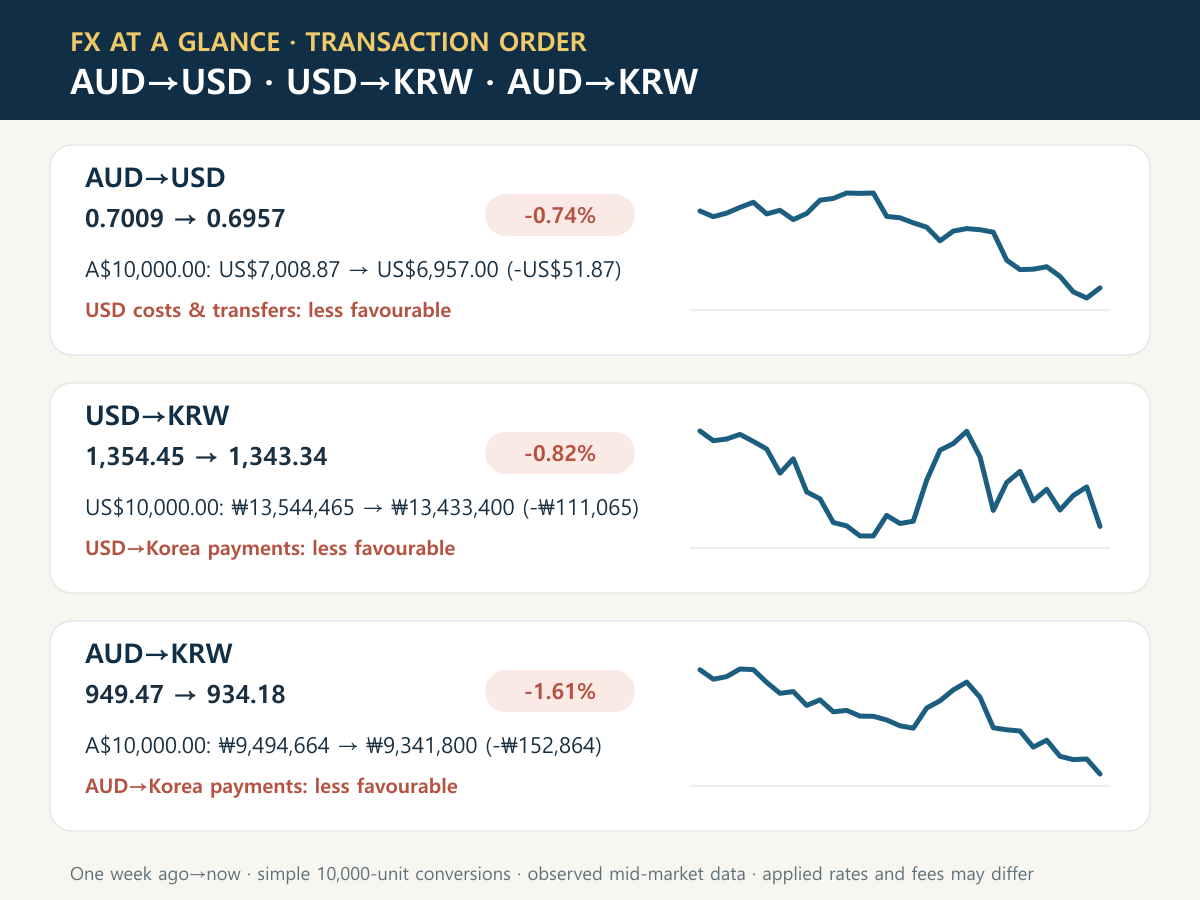
- AUD→USD: 0.7009 → 0.6957 (-0.74%). Converting A$10,000.00 would have changed from US$7,008.87 to US$6,957.00, a difference of -US$51.87. This was less favourable for Australian businesses paying or sending USD; the effect is reversed for a business converting fixed USD receipts back to AUD.
- USD→KRW: 1,354.45 → 1,343.34 (-0.82%). Converting US$10,000.00 would have changed from ₩13,544,465 to ₩13,433,400, a difference of -₩111,065. This was less favourable for businesses converting USD to KRW for Korean payments; the effect is reversed for a business converting fixed KRW receipts back to USD.
- AUD→KRW: 949.47 → 934.18 (-1.61%). Converting A$10,000.00 would have changed from ₩9,494,664 to ₩9,341,800, a difference of -₩152,864. This was less favourable for Australian businesses paying Korean suppliers in KRW; the effect is reversed for a business converting fixed KRW receipts back to AUD.
Read the Monday FX and business-payment guide →
Mid-market observations. This is not an FX forecast or a recommendation about remittance timing.
One insight from WBAU transfer data
Korea-bound business transfers: 43.2% in USD
43.2% of 2,037 Korea-bound business transfers were received in USD. This is a share of transaction counts, not value.
- Received in USD: 43.2% (881 transfers)
- Received in KRW: 56.8% (1,156 transfers)
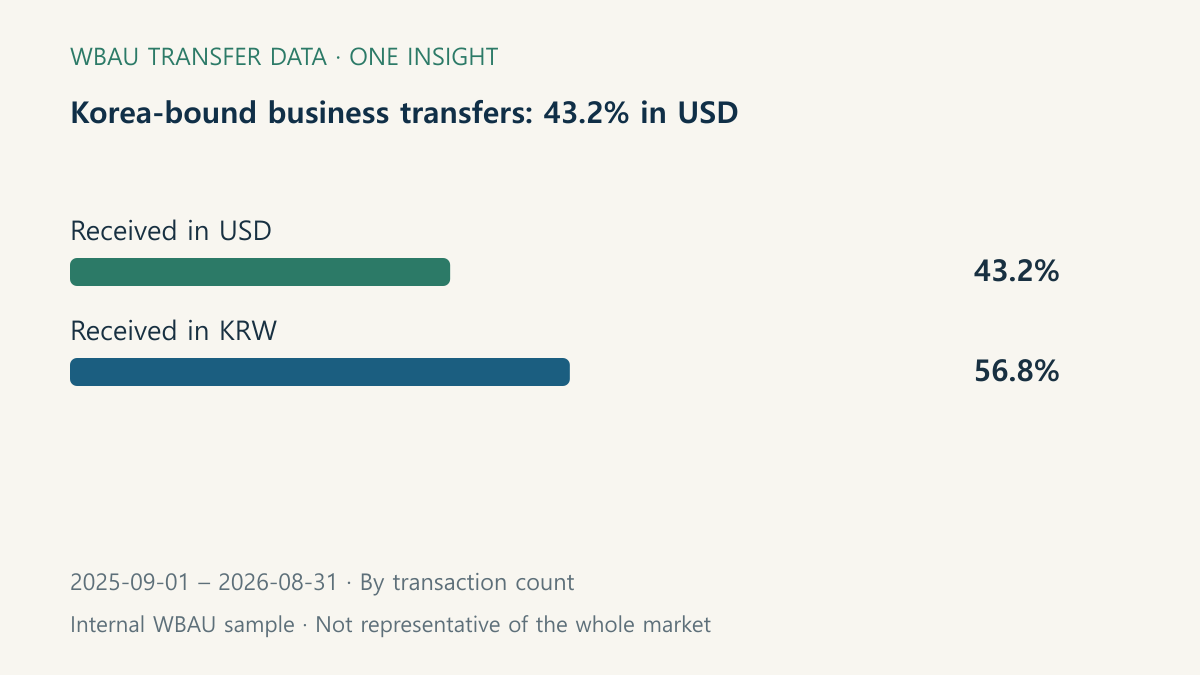
A Korean counterparty does not necessarily receive KRW. Checking invoice and receipt currencies helps distinguish AUD/USD from AUD/KRW exposure. This aggregate does not establish why USD was chosen or which currency is better.
Basis: 2025-09-01~2026-08-31 · Internal WBAU AU→KR B2B transfers sent in AUD, with paid/approved status, deduplicated by transfer number. Not representative of all Korean businesses in Australia; customer nationality is not classified. No customer identities or individual transactions are disclosed.
This week in 30 seconds
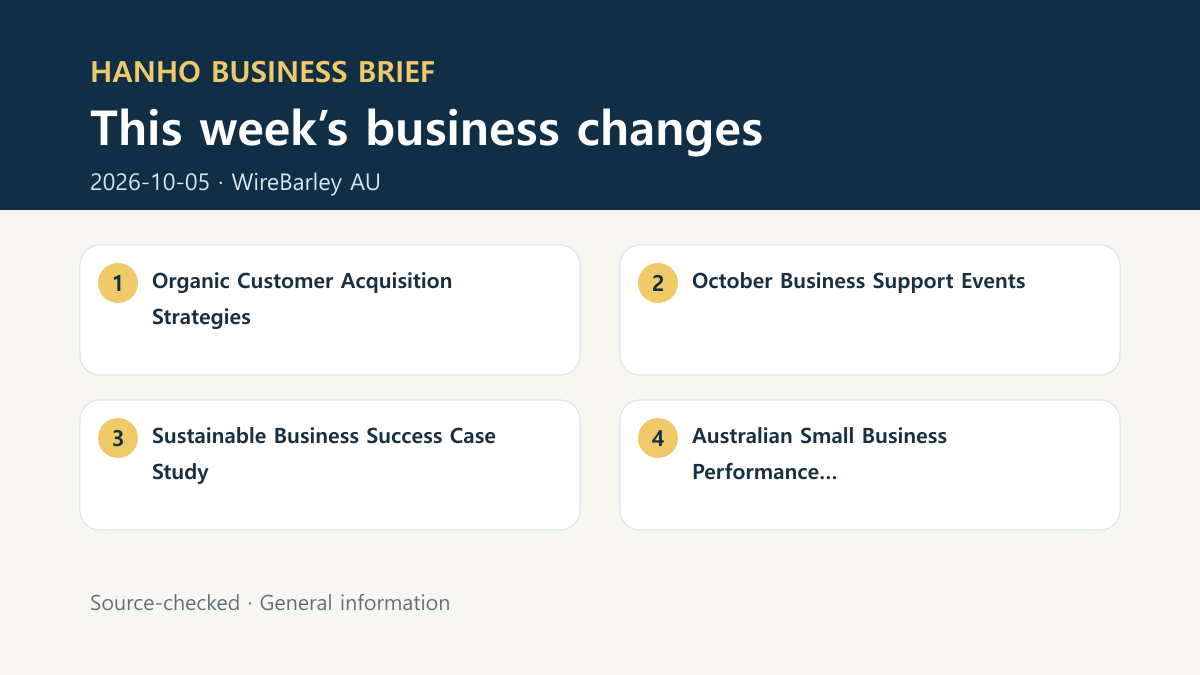
- [Practical guide] Provides practical methods for acquiring organic customers through personal branding, email list building via simple lead magnets (e.g., checklists), and cross-industry collaboration, instead of costly social media advertising.
- [Practical guide] Provides a comprehensive schedule of safety and health checks, cybersecurity checks, Indigenous business collaborations, mental health initiatives, and state-specific small business support events for NSW and NT in October.
- [Business case] Shares a business operation experience suggesting a redefinition of success criteria focused on community relationships, customer experience, and the owner’s sustainable lifestyle, rather than solely on sales and expansion.
- [Research] Australian small business sales increased 6.5% year-on-year (y/y) and employment by 3.0% in the June 2026 quarter, but growth slowed compared to the March quarter due to interest rate hikes and rising oil prices.
Deadlines to check (next 14 days)
- No recurring lodgment or payment deadline falls within the next 14 days.
- Ongoing · Payday Super — super guarantee received within 7 business days of payday — All employers (from 1 July 2026) (The former quarterly SG due dates no longer apply from 1 July 2026; each payday is the trigger.) source
Based on official pages (verified 2026-09-02). Confirm your own lodgment type and any extension with your accountant.
1. Organic Customer Acquisition Strategies
Practical guide · not a new rule · Source published: 2026-10-02
Source: Inside Small Business.
Status: guidance · Relevant to: Small and medium-sized businesses and 1-person founders looking to reduce paid advertising costs and directly acquire loyal customers and leads.
Provides practical methods for acquiring organic customers through personal branding, email list building via simple lead magnets (e.g., checklists), and cross-industry collaboration, instead of costly social media advertising.
Business impact: Can help reduce spending on paid advertising (e.g., Meta) to save initial costs, and mitigate risks from platform algorithm changes by building an email-based prospect list and collaboration network.
General matter to check: Can check if a free template/checklist that solves part of a customer’s problem has been created and if there are complementary industry partners for collaboration.
2. October Business Support Events
Practical guide · not a new rule · Source published: 2026-10-01
Source: business.gov.au — News (비용·현금흐름·고객·온라인 판매·사업 운영·지원제도).
Status: guidance · Relevant to: Small and medium-sized businesses across Australia and self-employed individuals in NSW and NT.
Provides a comprehensive schedule of safety and health checks, cybersecurity checks, Indigenous business collaborations, mental health initiatives, and state-specific small business support events for NSW and NT in October.
Business impact: Can reduce hacking risks through cybersecurity multi-factor authentication and backup checks, and strengthen marketing, AI, and cash flow management capabilities by utilising free/low-cost seminars organised by state governments.
General matter to check: Check workplace safety and health systems and system security settings, and confirm the schedule of small business support events in the relevant state.
3. Sustainable Business Success Case Study
Business case · results are not guaranteed · Source published: 2026-09-28
Source: Inside Small Business.This is an individual experience, not a guarantee of results for other businesses.
Status: guidance · Relevant to: Small and medium-sized businesses considering sustainable operating methods and customer-centric value creation.
Shares a business operation experience suggesting a redefinition of success criteria focused on community relationships, customer experience, and the owner’s sustainable lifestyle, rather than solely on sales and expansion.
Business impact: Focusing on building genuine customer relationships and contributing to the community, rather than pursuing only outward growth, can positively influence long-term customer retention and natural sales maintenance through recommendations.
General matter to check: Check what the core values and customer satisfaction elements pursued by your business are, and assess if sustainable operating methods are established rather than pursuing excessive expansion.
4. Australian Small Business Performance Q2 2026
Research · findings within the stated sample · Source published: 2026-07-30
Source: Xero Small Business Insights. Period and scope (source excerpts): XSBI Australia April 2026 - June 2026 data / This report was prepared using Xero Small Business Insights data and publicly available data…. Limitations: The payment period improvement figures for the June quarter are provisional, reflecting year-end seasonal factors, and may be revised upwards in the future.
Status: guidance · Relevant to: Small business operators in Australia (especially in consumer and interest-rate sensitive sectors like hospitality, retail, and real estate).
Australian small business sales increased 6.5% year-on-year (y/y) and employment by 3.0% in the June 2026 quarter, but growth slowed compared to the March quarter due to interest rate hikes and rising oil prices.
Business impact: Slowing growth in discretionary spending sectors like hospitality and retail, along with rising input costs, may continue to pressure cash flow and profitability.
General matter to check: It is necessary to check if the business’s cash flow and cost structure are stable, considering the economic slowdown trends by industry and the average payment collection period (22.9 days).
WireBarley AU update
Korean-speaking support is available for businesses checking Korean remittance or onboarding arrangements.
- WireBarley Business
- +61 1300 252 073
- WireBarley AU Kakao Channel
This brief provides general information, not individual tax, employment, legal, customs or foreign-exchange advice. Check the official source and seek appropriate professional advice. Contributors include a former CPA.