
“Used EVs are about to flood the market. Should I wait a bit before buying?”
It’s a line you hear a lot from people shopping for a car in Australia right now. New EVs have grown, and people who took an EV on a novated lease a few years ago are starting to hit lease end — so it makes sense.
But the Hanho Money way, the question shifts a little. Why are used EVs increasing, and will that stock really hit the market all at once?
Straight answer: the used-EV market is clearly growing. But the picture of “wait a little and great cars pour out cheap” is too simple. A few years’ worth of tax breaks is creating today’s used supply — but ex-lease cars don’t all come to market on the same day.
The bottom line
- Behind the rise in used EVs is not just new-car sales growth, but novated leases and the FBT exemption
- In the first half of 2026, Australian used-EV sales rose 54.6% year-on-year. The market is already growing
- But ex-lease cars don’t all list immediately. Some extend, some are bought out and driven longer, so supply arrives staggered
- Don’t judge the battery on the average alone. Large inspection datasets show average SoH above 96%, but a used car ultimately needs a per-vehicle test
- Early in settling, three things come before the sticker price: a home you can charge at, whether your first-12-months cash flow holds, and whether battery/warranty records exist
Why used EVs are rising now
Most people think “EVs are popular, so used ones grew too.” True — but only half true.
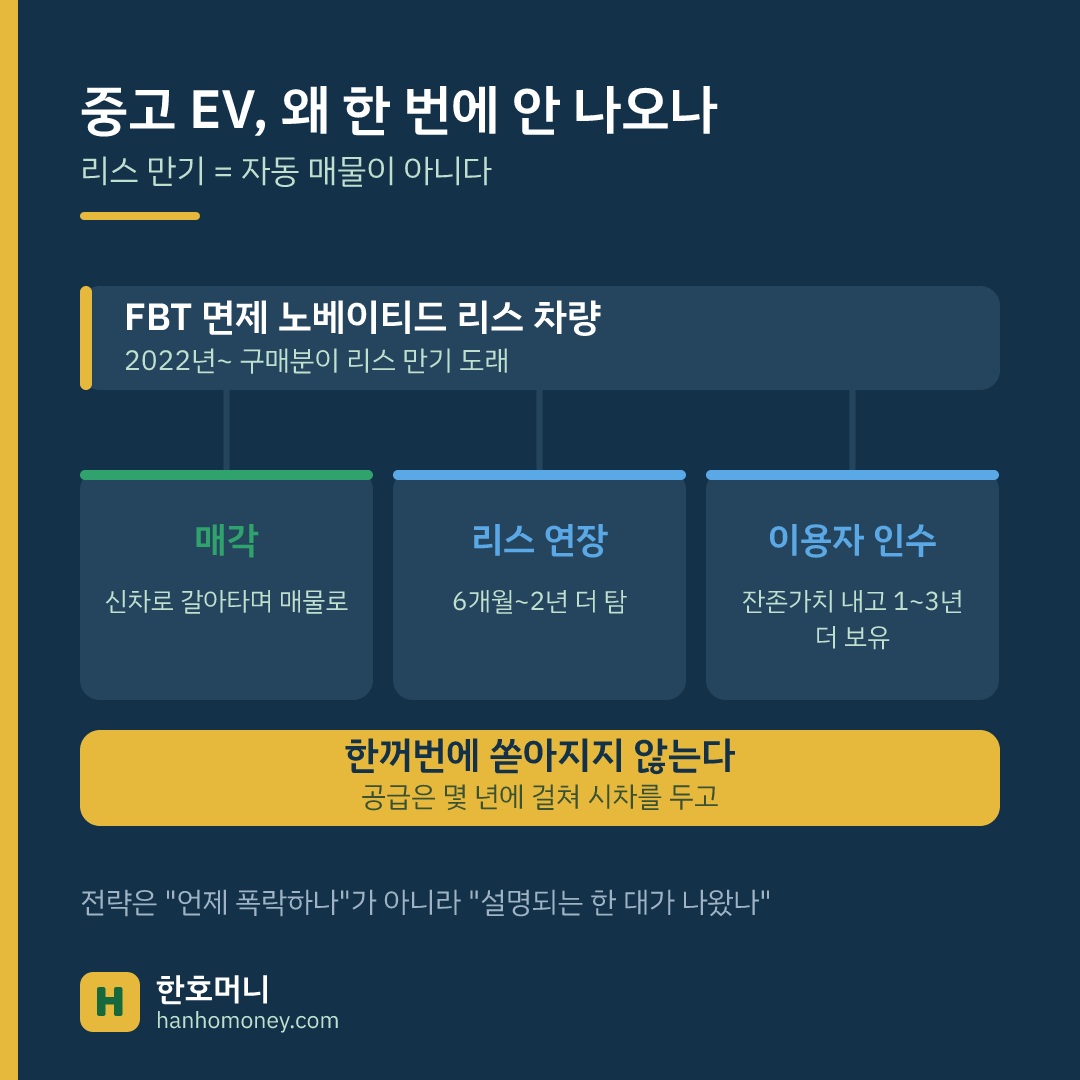
Since 2022, Australia has applied an FBT (Fringe Benefits Tax) exemption to eligible EVs taken on a novated lease. Put simply, salary packaging made running an EV much cheaper.
That surge in EV demand returns to the used market a few years later at lease end. A tax break created new-car demand, and that demand becomes used supply over time. Today’s used-EV market is a battery-technology story — and equally a result of tax policy from a few years ago.
According to the AADA, used-EV sales rose 54.6% year-on-year in the first half of 2026. Meanwhile the overall used-car market shrank over the same period. EVs alone are showing a separate growth trend. (AADA used-car market report)
What “prices about to crash” misses
Lease end doesn’t automatically send a car to market.
Some extend the lease; some pay the residual value and buy it outright; some sell as they move to a new car. Even for cars signed at the same time, the moment they hit the market differs.
So used-EV supply is more likely to spread out over years than pour out like a waterfall at once.
New-car price cuts do pressure used prices, of course. As new EV choices grow and prices come down, used cars struggle to hold their old prices. But model-by-model differences are large. In-demand models, brands with strong charging and service networks, and cars with clear battery and warranty records move differently even among EVs.
So the strategy isn’t guessing “when does it crash.” It’s closer to: at the point you actually need one, did a car appear whose condition and price make sense?
There’s a cost to waiting months for the perfect car too — hire-car fees, public-transport time, the friction of early settling.
Let me ask you this. Are you the “waiting for it to get cheaper” type, or the “grabbing one car with a clean inspection report” type? Looking at how this supply is structured, I think the latter is more rational — because the stock doesn’t arrive all at once.
Battery worry — the average matters less than the one car you buy
The biggest worry with a used EV is the battery. That it’s harder to judge simply than an engine car’s odometer adds to the anxiety.
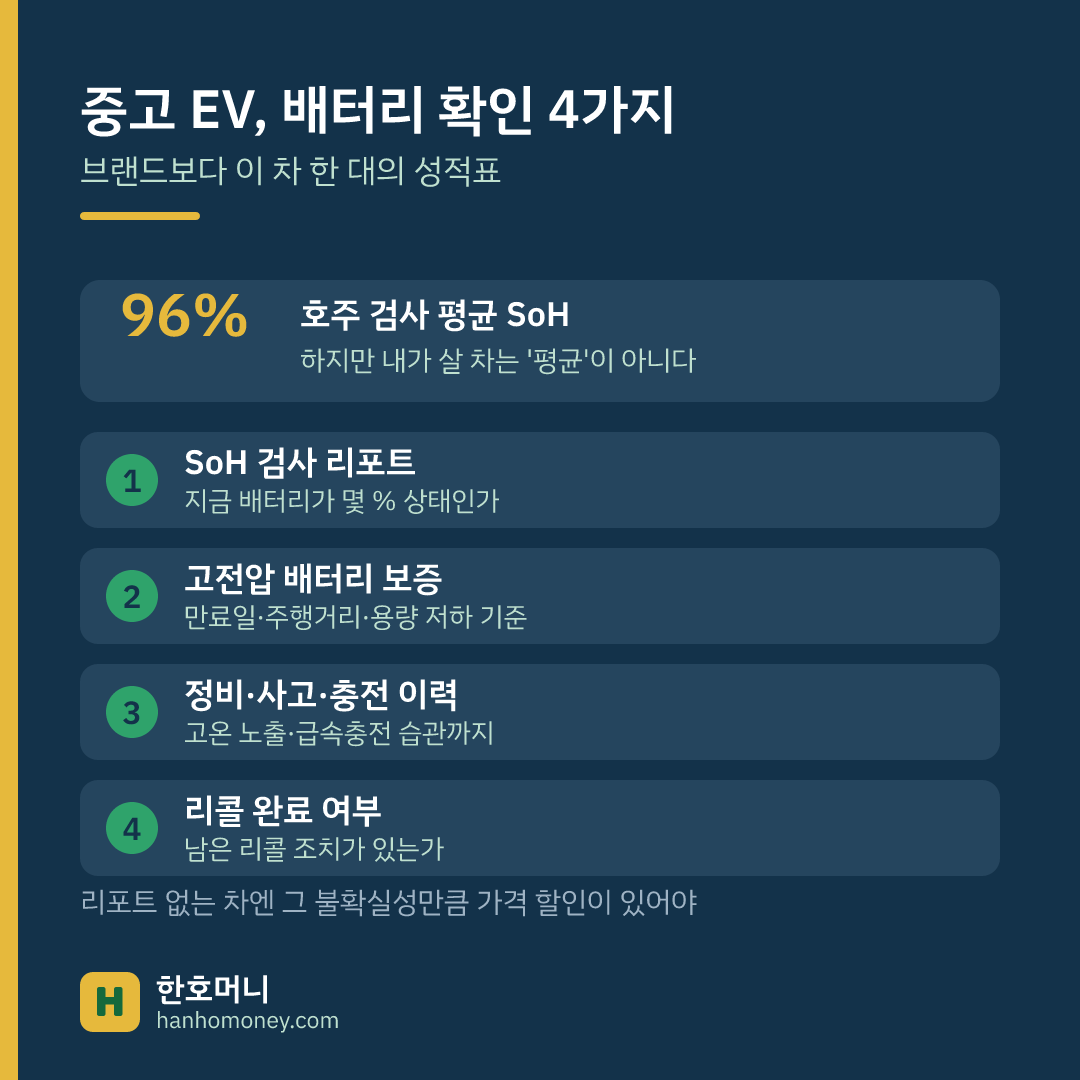
But early data from Australia’s auction and inspection market is far from the excessive fear. Pickles reported an average battery SoH (State of Health) above 96% across more than 1,500 EV inspections. SoH measures how much of its original performance a battery retains versus when new. (Pickles EV battery data) Later reporting in July 2026 said the average State of Health stayed around 96% across more than 2,500 battery tests too. That the average holds even as the sample grows lends the market a little more confidence.
But don’t jump from there to “so they’re all fine.”
The average is just the average. Heat exposure, charging habits, driving conditions and accident/repair history can leave the same year and mileage in different shape. In a used purchase, the inspection result of the one car you’re signing for matters more than the average.
Before buying, check:
- Is there a battery SoH inspection report?
- How much high-voltage battery warranty remains?
- Can you verify charging/service and accident history?
- Does the real usable range fit your daily area?
- Are all recalls completed?
No battery report doesn’t automatically mean a bad car. But a car without a report should carry a discount equal to that uncertainty.
Look at battery chemistry and warranty, not just the brand
Shopping used EVs, you’ll hear “Tesla batteries are good,” “BYD batteries last.” Not entirely wrong, but too blunt for a buying decision.
Battery life isn’t decided by brand alone. Battery chemistry, the thermal-management system, charging habits, driving conditions, and that one car’s actual condition all work together.
| Type | Common traits | What a used buyer checks |
|---|---|---|
| LFP (lithium iron phosphate) | Strong on durability and thermal stability, common in budget EVs | Check the maker’s full-charge guidance; SoH and real mileage |
| NMC / NCA (nickel-based) | Better for long range at the same weight, used in many longer-range EVs | High-power fast-charging / heat exposure history, thermal management and warranty left |
| Chemistry unknown | Many used listings omit battery info | Confirm maker/dealer by VIN; require an independent battery test |
There’s plenty of research and data that LFP is theoretically favourable for life and safety. But it doesn’t mean “LFP therefore lasts forever.” Conversely, NMC and NCA cars can stay in great shape for a long time if thermal and charge management were good.
In the used market, this question beats the chemistry label:
What percentage is this car’s battery at right now, and how much warranty is left?
Warranty isn’t a promise the battery stays like new
In Australia, many EV makers put an 8-year / ~160,000km warranty on the high-voltage battery. For example, BYD and Hyundai advertise 8-year or 160,000km high-voltage battery warranties in Australia. Toyota specifies repair or replacement if capacity falls below 70% of the original, provided servicing conditions are met.
But warranty terms differ by maker, model and first registration date. And a warranty usually turns on whether it dropped below a set threshold, not “performance dipped a little.”
So before signing, verify these yourself rather than the seller’s word:
- The battery warranty expiry date and mileage condition for that car
- The warranty’s capacity-degradation threshold and exclusions
- Scheduled service history and recall completion
- An independent battery report’s SoH, cell anomalies and charging history
One thing the data says: the average is fine, but a listing isn’t the average
Similar to the Australian inspection data above (average SoH above 96%), large UK used-EV inspection datasets also put average SoH around 95% across makers and years.
The message isn’t “don’t worry about the battery.” It’s that you don’t need to avoid used EVs out of battery fear, but you shouldn’t treat the average as your car’s report card. A good used-EV purchase belongs less to someone who memorises chemistries and more to someone who picks the one car that has a warranty and an inspection report.
Battery type is information that narrows the shortlist. The battery inspection result is information that decides the contract.
Are ex-novated-lease cars worth a look?
In used listings you may see “ex-novated lease.”
You can’t say these are automatically better than ordinary fleet cars. But there’s a reason to look. A novated-lease driver has a stake in the residual value and the car’s condition at lease end — treat the car badly and the lost value can come back on them.
So when looking at ex-novated-lease cars, it helps to ask:
- Was it mostly personal use, or heavy business mileage?
- Is there a scheduled service record?
- Is there a pre-lease-end battery/vehicle condition check?
- Is it being flipped straight after a residual buyout?
You don’t need to conclude anything from the phrase “ex-lease” alone. But it’s a clue to read the service history and contract structure together.
Early in settling, what to look at before the EV
When a used EV looks cheap, it’s easy to compare only the sticker price. But early in settling in Australia, a car — along with rent — is one of the biggest movers of your cash flow.
1. Can you charge at your rental home?
If you’ll live in an apartment or unit rather than a house with a garage, charging isn’t an option — it’s a living condition. Check first whether you can install a charger at your space, what the strata approval process is, and whether nearby public-charger costs and wait times are bearable. If you can’t charge comfortably at home, even a cheap EV can be a pricier choice than it looks.
2. Not the sticker price — the first 12 months of cash flow
Don’t look at the purchase price alone; add these up:
- Car price and loan/lease repayments
- Insurance
- Rego, servicing, tyres
- Charging cost or public-charging cost
- Parking and tolls
- Rent bond, furniture and living costs of the first few months
If too much cash gets locked up early in settling, even a great car can make your whole life tight. A car is an asset, but right now it’s cash flowing out every month.
3. Depreciation is decided by the next buyer, not the brand
Residual values for used EVs still vary widely by model. The fewer things the next buyer has to worry about, the easier it is to defend value. Service network, parts supply, battery warranty, charging standard, brand trust, an inspection report — these reduce the next buyer’s anxiety. If you think about resale, weigh tomorrow’s saleability as much as today’s low price.
Checklist before you buy
- There’s a realistic way to charge near home or work
- You’ve checked battery SoH and high-voltage battery warranty
- You’ve checked accident/service/recall history
- You’ve costed the first 12 months including insurance and charging
- You’ve compared listings of similar year and mileage
- You judged whether you need the car now — not “because it might drop further”
Wrap-up
Australia’s used-EV market is growing. But its background isn’t a fad — it’s tax policy from a few years ago — so supply comes staggered, not all at once. Batteries are strong on average, but the car you’ll buy isn’t the average.
The Hanho Money conclusion: a used EV isn’t a game of timing the market — it’s picking the one car you can explain.
One last question. Is the reason you’re delaying a car “because it might get cheaper,” or “because charging and cash flow aren’t ready yet”? If it’s the former, think again; if it’s the latter, delaying is right. Share your situation in the comments and I’ll think it through with you.
Related reading
- Australia’s EV FBT Exemption Winds Down From 2027 — Here’s How
- Novated Lease — Can the Self-Employed Save Tax on an EV?
- The Real Fear in Settling in Australia Is ‘Locked-Up Cash’
- Why Australian Rents Keep Rising Even as Prices Ease
- Korea–Australia Money Map
This is general information, not vehicle or financial advice. The used-EV market and battery condition vary widely by model, year, mileage, service history and purchase timing. Get an independent inspection, confirm battery condition and check warranty terms before buying. FBT eligibility and tax treatment depend on your situation — confirm with a Registered Tax Agent.
Sources: AADA H1 2026 used-car market data · Pickles EV battery data · ATO electric-car FBT exemption · Drive (July 2026) reporting.