
“Foreigners will be able to open won accounts at overseas banks.”
A headline like that catches the eye — even more so if you’re a Korean living in Australia. “So can I open a won account at an Australian bank now?” “Will transfers to Korea get cheaper?” “Will the exchange rate improve if the won goes global?” “Will investing in Korean stocks get easier?”
Good questions. But first we have to separate one thing. A policy’s direction and the moment it actually reaches your account are different.
The won internationalisation roadmap the government is pursuing is a genuinely big shift. The direction is to make the won a currency you can hold, settle and trade more freely. But that doesn’t immediately mean “a Korean in Australia opens a won account at an Australian bank tomorrow.”
The Hanho Money read: the core of this news isn’t celebration, it’s distinction. Who does it open for? When does it start? Through what path does it touch my remittance, FX and investing?
The bottom line
- The government is pursuing a roadmap to shift the won from a regulated currency toward something closer to freely convertible
- The focus is letting foreigners and foreign financial institutions hold, source and settle won more easily
- The main pillars are the Bank of Korea’s offshore won settlement network, a 24-hour FX market, and better foreign-investor access
- But it doesn’t change a Korean-Australian’s transfer fee or exchange rate right now
- Long term, it can lead to more offshore won liquidity, better overnight/weekend trading, and easier access to Korean assets
- What to do now is not front-run it with trades — it’s to watch the start dates and who it applies to
① What was announced — put simply
The won is still classed as a currency with many restrictions in global markets. Unlike the dollar, euro or yen — easy to hold, settle and trade offshore — using the won as a foreigner has meant going through Korea’s domestic FX market, domestic institutions and regulatory steps.
The government’s won internationalisation roadmap is a plan to change that structure in stages. Put simply: turn the won from money used mainly inside Korea into money that’s easier to use abroad too.
The key mechanism is an offshore won settlement network. The Bank of Korea would build new settlement infrastructure so foreign institutions can source and settle won more smoothly. According to reporting, this network is being prepared to run 24 hours from January 2027.
This isn’t just an FX story. The FX market, remittance, Korean stocks, foreign investment and the MSCI developed-market upgrade debate are all connected here.
② But ‘who’ it’s for matters most
The most important question here is this. Who is the first target of this policy?
Read the article closely and the subject is mostly foreign investors and foreign financial institutions.
- Foreign institutions source won
- Foreigners hold won more easily offshore
- Foreign investors’ access to Korean assets improves
- Settlement and trading infrastructure is built offshore
In other words, this is a policy to push more won out into global markets. Read the other way, jumping straight to “a Korean in Australia easily opens a won account at Commonwealth Bank tomorrow” is getting ahead of it.
For migrants, indirect effects are likely to arrive before direct ones. Overseas banks, global brokers, remittance firms and fintechs gradually change how they handle won, and that later flows down into consumer services. Policy lays the road; the financial institutions drive the cars.
③ What actually changes for me, the person sending money
From a remittance angle, the realistic questions are: Do fees drop? Do spreads narrow? Does processing get faster?
Honestly — it probably won’t change much right away. Sending money Korea↔Australia is priced in many layers: the market rate, the FX spread, the transfer fee, correspondent-bank costs, local settlement structure, weekend/overnight liquidity, and each provider’s risk-management cost. Won internationalisation doesn’t cut all of these overnight.
But long term it matters. If won trades more abundantly offshore and 24-hour settlement runs reliably, institutions gain more options to source and settle won. More options can bring competition and efficiency. Over time that can mean tighter overnight/weekend won spreads, better won settlement for overseas brokers, faster transfers, and cleaner FX/settlement when investing in Korean assets.
But that’s a “possibility,” not “today’s fee cut.”
④ Same root as 24-hour won trading
This roadmap didn’t come out of nowhere. Korea has already been extending FX market hours and widening foreign-institution participation. Expanding 24-hour won trading is part of that flow.
Previously, trading or settling won while Korea’s market was closed carried big constraints. From Australian time that gap feels larger — Korea and Australia have a time difference, and once US and European sessions overlap, the timing of won trades becomes a real cost.
Won internationalisation tackles this in a bigger frame: let the won trade any time, and let it settle offshore too. If it works well, Korean money becomes more global. But going global isn’t all upside. Money that flows in more easily also flows out more easily. More trading can improve liquidity, but also raise volatility. That’s exactly why the roadmap talks about volatility management and safeguards alongside it.
⑤ Why Korean stocks and MSCI keep showing up together
MSCI keeps appearing in won-internationalisation news. That’s no coincidence.
One thing Korea has long been flagged on for MSCI developed-market inclusion is foreign-investor access. Even with good companies and a large market, if foreign investors find trading, FX, settlement and disclosure inconvenient, it’s hard to treat the market as “developed.”
The remaining tasks noted in the roadmap connect to this flow: settlement automation, better foreign-investor registration/verification, expanded English disclosure, and improved won trading/settlement infrastructure.
For a Korean-Australian investor, this is a long-term checkpoint. If you buy Korean stocks directly, watch the Korean market via a global broker like IBKR, or hold Korean ETFs, won internationalisation is the background infrastructure. It’s not a news item that makes you buy a stock today — but it’s the process of Korea becoming an easier market for foreigners.
⑥ For migrants, indirect effects arrive before direct ones
For a Korean-Australian, expecting too much from this news can lead to disappointment. “Now I can open a won account in Australia.” “Transfer fees will drop right away.” “The won will strengthen.” “Korean stock trading gets easy immediately.”
Some of these may be possible over the long run. But right now it’s the roadmap stage. Real effects usually arrive in this order:
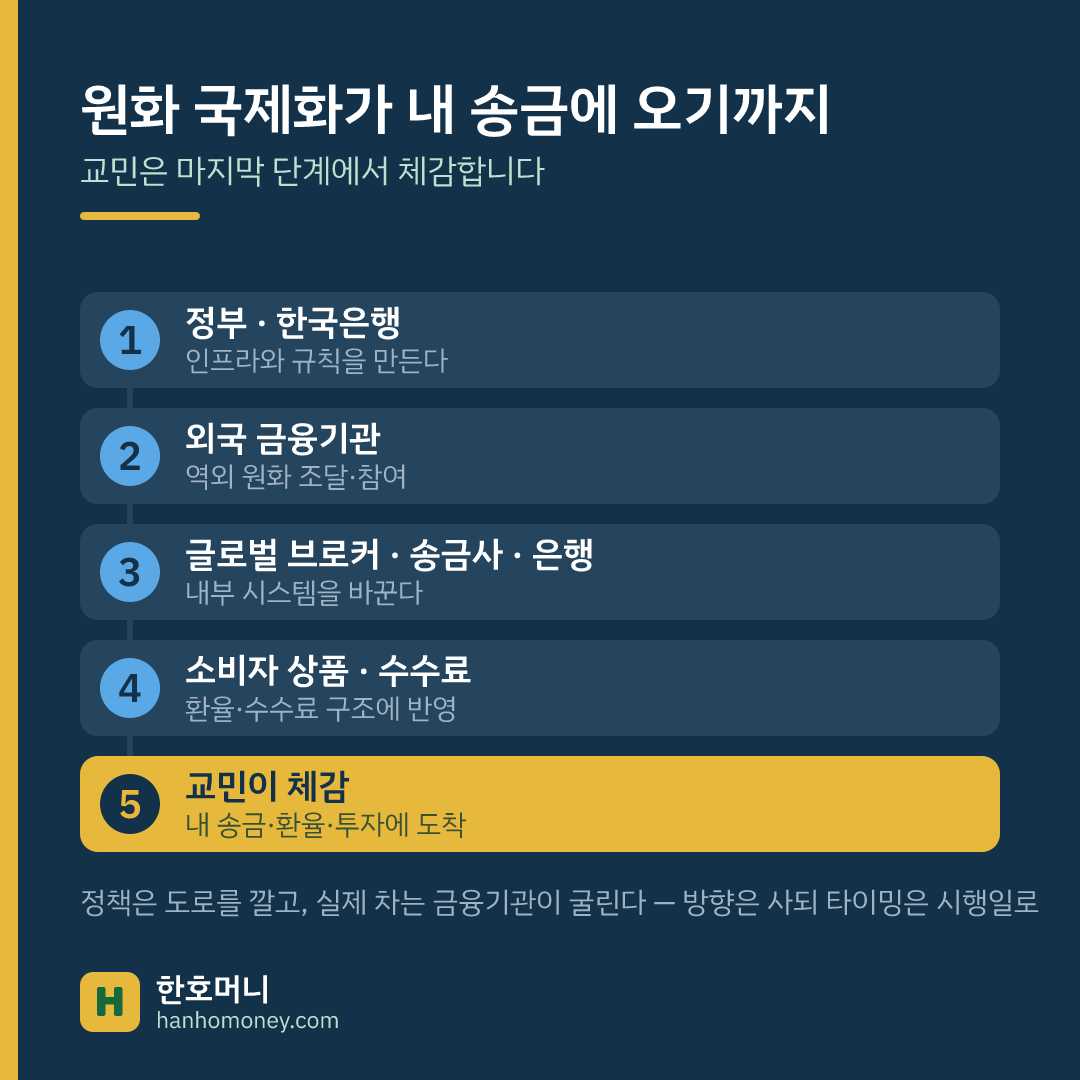
- Government and the BOK build the infrastructure and rules
- Overseas and foreign financial institutions participate
- Global brokers, remittance firms and banks change their internal systems
- It flows into consumer products and fee structures
- Migrants feel it
Migrants usually feel it at the last step. So this isn’t “give up your expectations” — it’s line up the timing of your expectations.
⑦ What to do now — checkpoints, not front-running
When policy news like this drops, you want to forecast the rate. “If the won internationalises, won’t it strengthen?” “Should I convert now?” “Won’t Korean stocks rise too?”
Be careful. Won internationalisation is a multi-year structural change. Along the way the exchange rate keeps swinging on US rates, Korean exports, foreign flows, geopolitics, equities and commodities. So making a big FX or investment decision off this news is risky. Instead, set checkpoints.
| Checkpoint | Why it matters |
|---|---|
| Offshore won settlement network live (2027) | Whether the actual settlement infra opens |
| Range of participating foreign institutions | Whether it connects to the banks/brokers/remitters you use |
| Stability of 24-hour won trading | Room for tighter overnight/weekend spreads |
| Details of eased foreign-investment rules | Whether Korean-stock access improves |
| Progress on remaining MSCI tasks | Odds of Korea’s global index inclusion |
| Actual rate/fee changes at remittance firms | The final point where migrants feel it |
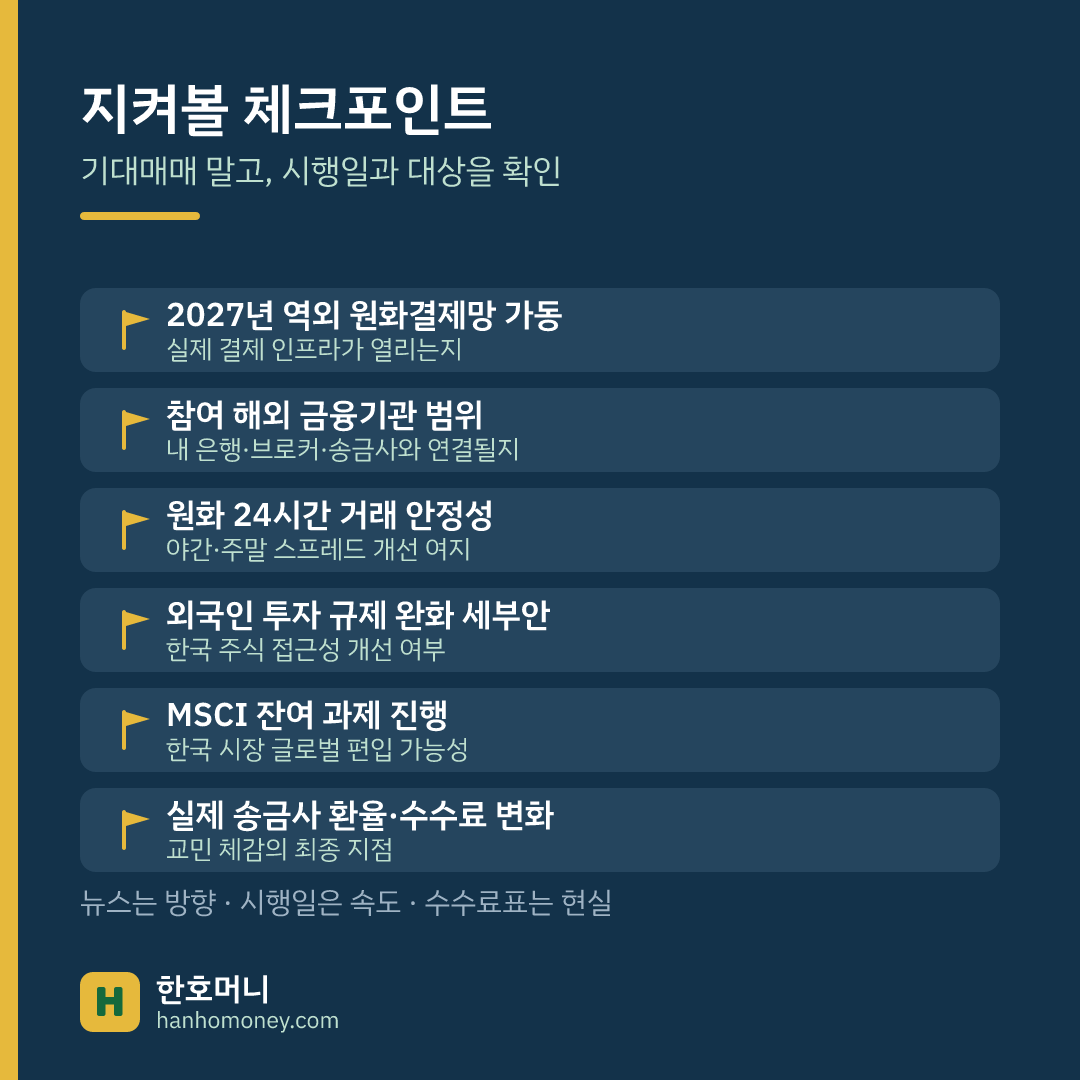
News tells you the direction. Start dates tell you the speed. The fee table tells you the reality.
Wrap-up
The won internationalisation roadmap is big news — an attempt to turn the won from money used inside Korea into money used more freely in world markets. The 24-hour FX market, the offshore won settlement network, better foreign-investment access and the MSCI tasks all point one way.
But the Hanho Money conclusion is a little calmer. This news doesn’t change your transfer fee today; it’s a signal that remittance, FX and investment infrastructure may change ahead. So it’s not a reason to make a big conversion today. It’s a checkpoint to keep watching over the next year or two.
The closer the won gets to being global money, the more the money-road between Korea and Australia can shift. But that change arrives at the speed of infrastructure and start dates — not the speed of headlines.
So one last question. Did you read this as “am I getting a won account now?” — or as “a big multi-year direction”? If it just gave you one more reason to delay a big conversion, let that reason be the start date, not the hype.
Related reading
- The Won Now Trades 24 Hours — What Changes for Money Between Korea and Australia
- The Won Just Strengthened — Temporary, or Structural?
- The Real Cost of the AUD–KRW Exchange Rate
- Sending Money From Korea to Australia
- Investing in Korean Stocks From Australia — IBKR vs Bank Brokerage, and Tax
- Korea–Australia Money Map
This is general information, not investment, FX, remittance or tax advice. The won internationalisation roadmap is a phased policy direction, and its timing, scope and details may change. Before any transfer or investment, check each bank, broker and remittance firm’s rate, spread, fee, limit and processing time directly.
Source: ChosunBiz, “Foreigners to open won accounts at overseas banks and transfer won — government announces ‘won internationalisation roadmap’” (19 July 2026).