
“Rent’s gone up again.”
It’s the line you see most in Australian news right now. But rent is no longer just a question of “it feels expensive.” The real number to watch is different.
What share of my income goes to rent.
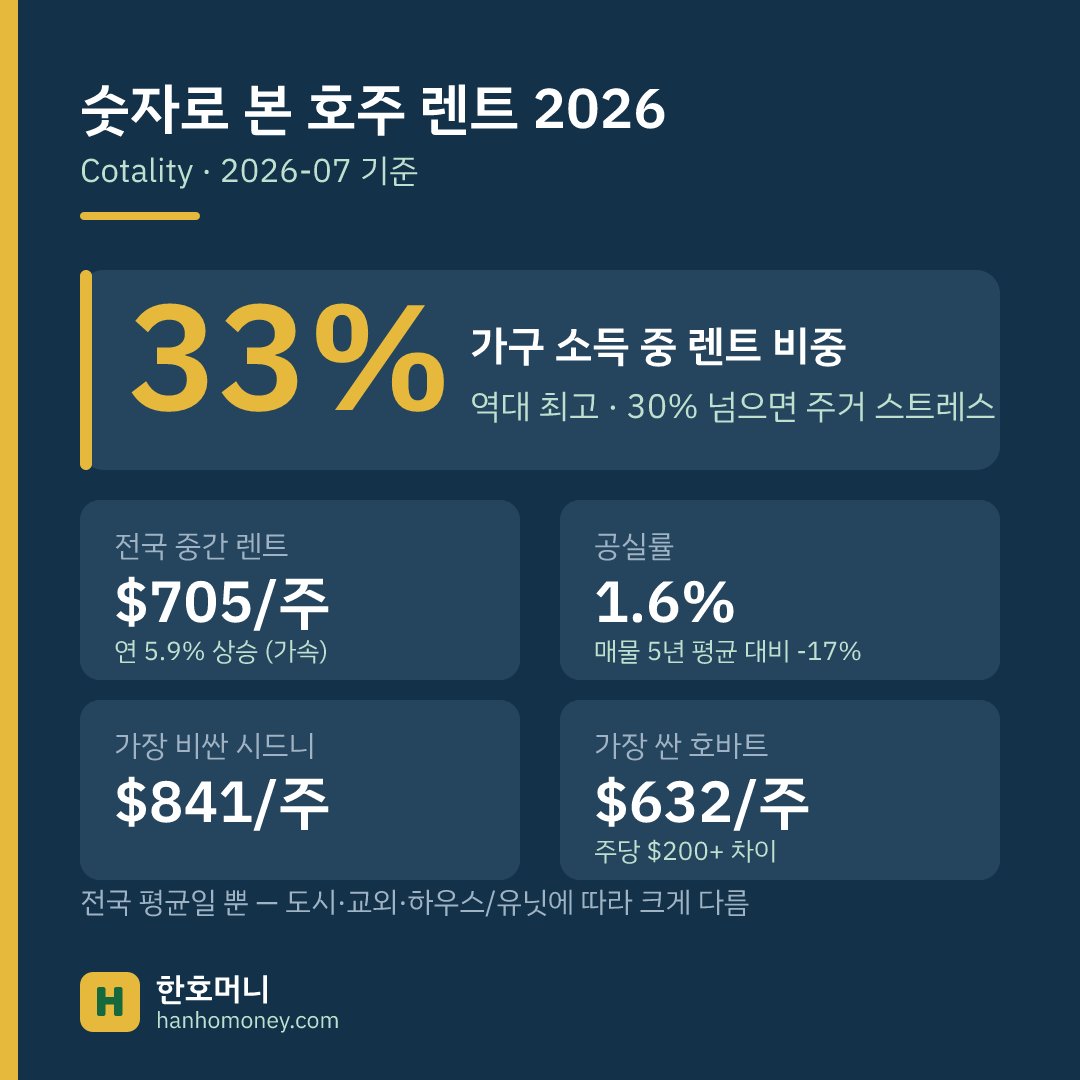
According to Cotality data reported in July 2026, Australian households spend about a third of their income on rent — roughly 33%. As a rule of thumb, spending over 30% of income on housing is often treated as housing stress.
In other words, even the average tenant is already living past the stress line. For migrants, students, working-holiday makers and new arrivals planning a move to Australia, this isn’t just property news. It’s a signal to reopen your budget.
The bottom line
- On Cotality figures, Australian households spend about 33% of income on rent
- The national median rent was reported around $705/week
- Rent growth is running near 5.9% a year — faster again than mid-2025
- “Slower quarterly growth” means “rising less quickly,” not that rent is falling
- With a 1.6% vacancy rate and listings below the five-year average, it’s still a landlord’s market
- What matters for you isn’t the national average — it’s your own rent-to-take-home ratio
- If rent passes 30% of your take-home, revisit your suburb, sharing, unit and commuting costs
① A third of income — why it matters
“$705 a week” is a big number. But what matters more is how much of your income it takes to pay it.
$705 a week is about $36,660 a year. For a household on $110,000 gross, that’s roughly 33%. On a take-home basis the felt share is even higher. Then add electricity, gas, internet, transport, insurance and food.
So “spending a third of income on rent” doesn’t just mean living in an expensive place. It means less emergency cash, a lower savings rate, and fewer options.
People moving to Australia usually look first at visa fees, flights, tuition and the exchange rate. But once you land, the biggest money leaving your account each week is rent. Rent goes out every week, without fail, once you sign. So if you get it wrong in your first budget, it pressures you all year.
② The 2026 rent burden, in numbers
On Cotality data reported in July 2026, the rental market is still tight.
| Metric | Figure |
|---|---|
| National median weekly rent | ~$705 |
| Rent as share of income | ~33% |
| Annual rent growth | ~5.9% |
| Quarterly rent growth | ~1.6% |
| National vacancy rate | ~1.6% |
| Rental listings | Below five-year average |
| Sydney median rent | ~$841/week |
| Hobart median rent | ~$632/week |
Glance at the numbers and you might just note “national median is $705.” But the gap between Sydney and Hobart alone is over $200 a week.
$200 a week is about $10,400 a year. That’s not just a lifestyle difference — it can be an emergency fund, a car, a child’s school cost, a flight home to Korea, or part of a visa fee.
③ Don’t be fooled by “growth is slowing”
A phrase shows up a lot in rent stories: “rent growth has slowed.” It sounds like good news. But be careful.
Slowing doesn’t mean falling. It means rising less quickly.
If quarterly growth eased from 2.1% to 1.6%, the pace slowed — but it’s still going up.
Bake that into a settling budget wrongly and you get trouble. “Rent will stabilise now.” “Next year will be similar.” “It won’t rise much at renewal.” Maybe — but it’s not guaranteed. When vacancy is low and listings are scarce, tenants have little bargaining power.
The Hanho Money read: “slowing growth” isn’t a reassurance signal. Read it as — rent may rise more slowly, but it hasn’t come down.
④ 1.6% vacancy — a landlord’s market
A 1.6% vacancy rate simply means there aren’t many empty homes. If only one or two in a hundred rentals are vacant, tenants have fewer choices. Good places go fast, open inspections get crowded, and you can submit several applications and still miss out.
In this market, budgeting only the weekly rent isn’t enough. Look at the costs before you even sign — short-term accommodation, Airbnb, hotels, storage, a hire car, travel to multiple inspections, furniture and appliances before move-in, and the bond plus advance rent.
The scariest thing early in settling isn’t a single weekly rent. It’s the cash flow during the stretch before you land a place.
In a low-vacancy market, the prepared applicant wins. It helps to have income evidence, bank balances, references, prior rental history, ID and an employment contract ready in advance.
⑤ The young and the newly-arrived get hit harder
Rent pressure doesn’t land on everyone equally. For someone with high income and assets, a $50/week rise is an annoyance. For a working-holiday maker, a student, a first-jobber or a just-settled family, a $50/week rise touches food and transport money.
Recent research and reporting show much higher housing stress among younger and lower-income people. The core isn’t age — it’s income. The problem isn’t “it’s hard because you’re young.” It’s that rent rose before your income had a chance to.
That structure applies to migrants too. When you first arrive, income isn’t stable yet. Your job may be casual, your spouse may not have started work, and with children come childcare and school costs. But rent starts from week one. So new arrivals should budget rent conservatively.
⑥ The 30% rule — your budget’s warning light
Rent over 30% of income isn’t automatically “wrong.” In cities like Sydney or Melbourne, going over 30% is often the reality. But 30% is a useful warning light — and look at it on a take-home, not gross, basis.
For example, if your monthly take-home is $6,000 and rent is $2,400, that’s 40%. Add electricity, internet, transport, insurance, food, phone, remittances to Korea and tuition, and there may be almost nothing left to save.
A simple way to read it:
| Rent as share of take-home | Reading |
|---|---|
| 25% or under | Relatively comfortable |
| 25–30% | Manageable; check other spending |
| 30–35% | Entering rent-stress territory |
| 35–40% | Time to restructure |
| 40% or more | Rethink suburb / sharing / dwelling type |
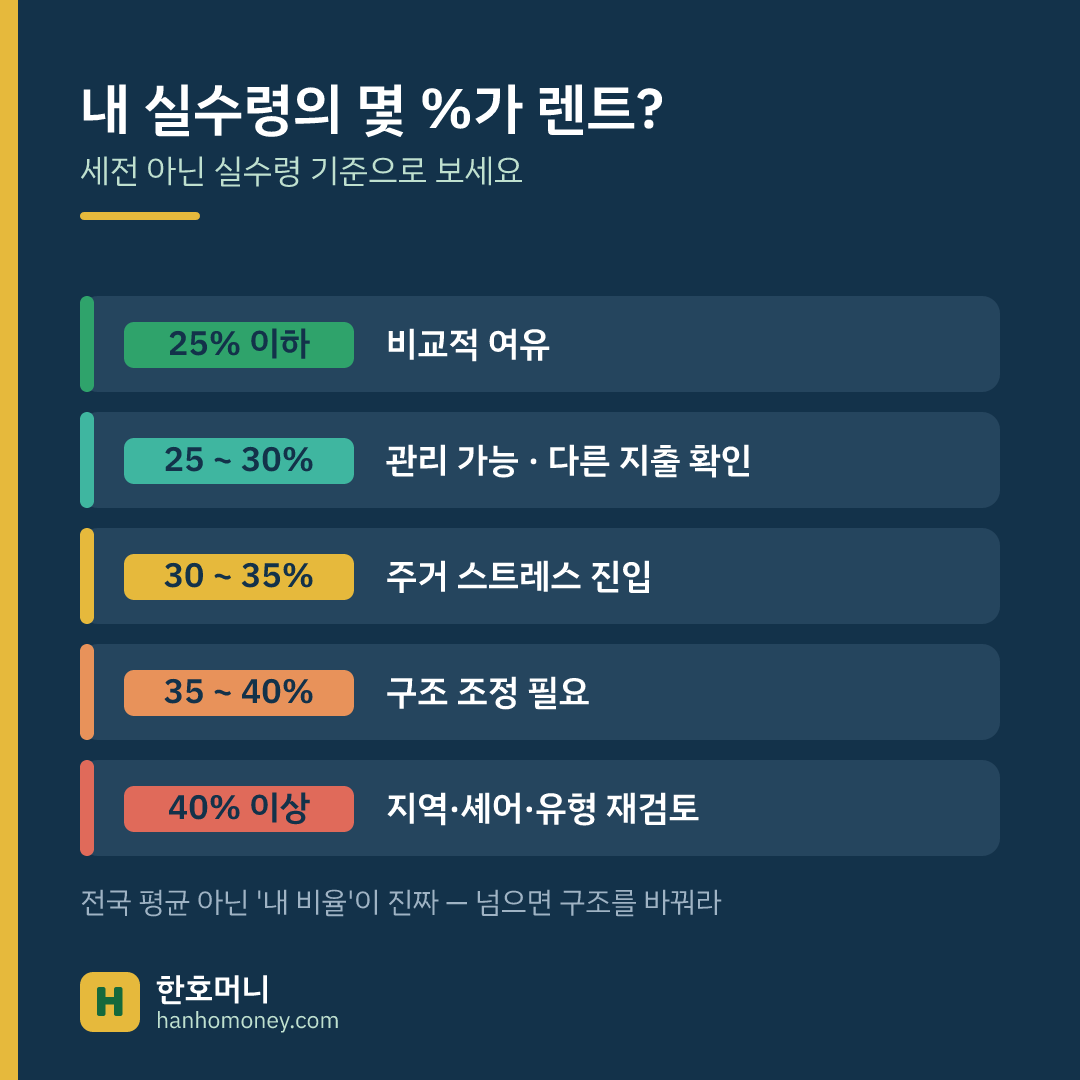
What matters isn’t the national average. It’s what share of your own pay your own rent takes. That number is the real one.
⑦ Practical moves for migrants — change the structure, not the mood
Rising rent breeds anxiety. But anxiety alone doesn’t change a budget. What you can change is the structure.
Change the suburb — Rents vary by neighbourhood even within Sydney. Near the CBD versus the outer suburbs is a big gap. But going further out adds transport cost and time, so don’t compare rent alone — compare rent + transport + time.
Move from a house to a unit — If family size allows, a unit can be a buffer early on. Houses give space but bring bond, higher bills, heating/cooling and often a need for a car. For the first 6–12 months, “a place you can sustain” can matter more than “the perfect place.”
Consider sharing — For working-holiday makers, students and single workers, sharing can be a realistic choice. You lose some privacy and stability, but it’s a powerful way to protect cash flow early on.
Build in a renewal buffer — Don’t look only at the first lease; look at the likely rise at renewal. If the rent is only just affordable now, a rise in 6 or 12 months can tip you over. Put at least a 5–10% buffer in your rent budget.
⑧ Here’s the real point — migrants can’t look at “rent alone”
Let me be honest. Working in remittance for years, I’ve watched how Korean-Australian households’ money actually moves — and the real danger early in settling isn’t rent alone. Three things hit in the same window.
- Rent — leaving in AUD every week (the 33% we just saw)
- Money moving to/from Korea — early on you’re either pulling funds from Korea or facing a cluster of transfers home. And if a lump sum moves when the exchange rate is bad, the loss is real.
- Income ramp-up lag — Australian income usually takes 6–12 months to settle. Rent starts week one; income arrives half a year later.
The window where these three overlap — the first 12 months — is the real danger zone for a migrant’s cash flow. Even with rent well-managed at 30%, add a badly-timed transfer and the felt pressure lands like 40–50%.
So here’s how I see it: a migrant should look at rent not as “30% of take-home,” but as rent + this month’s Korea transfers, as a share of take-home. A generic rent guide will never tell you this — it doesn’t look at remittances. But in a migrant’s wallet, rent and transfers leave the same account in the same month.
One question for you. Are you looking only at your rent ratio, or at the money flowing to and from Korea too? If it’s rent alone, put this month’s transfer plan next to it and add them up once more. The number will probably look quite different.
Not a lodgement checklist — a move-in checklist
Before signing a lease, run these numbers.
- What’s my monthly take-home?
- What share of take-home is the rent?
- With electricity, gas, internet, water and insurance added, what share is it?
- How much is tied up in the first month by bond and advance rent?
- Can I cope if temporary accommodation drags 2–4 weeks longer?
- Can I cope if rent rises 5–10% at renewal?
- Once you add transport, is the outer suburb really cheaper?
- Could I start with a unit or a share instead of a house?
Wrap-up
Australian rent can no longer be summed up as just “expensive.” You have to see what share of income it takes.
On Cotality figures, Australian households are already spending about a third of their income on rent. The national median is around $705/week, vacancy is low, and listings are scarce. In this situation migrants don’t need a forecast. Work out your own rent-to-income ratio, and if it passes 30%, revisit the structure.
The Hanho Money conclusion: rent isn’t a purchase price, it’s cash flow. Before the perfect home, lock in a ratio you can sustain.
So one last question. What’s your “rent + transfers” as a share of take-home right now? If it’s over 30%, what’s one structural thing you could change this month? Share your situation in the comments and I’ll think it through with you, using the cases I’ve seen.
Related reading
- Australian Rent by City 2026 — Sydney Houses Hit a Record $850/Week
- Why Australian Rents Keep Rising Even as Prices Ease
- The Money in an Australian Lease — Bond, Advance and the Cash That Gets Locked Up
- Working Holiday Startup Costs by City — Sydney, Melbourne, Brisbane
- Korea–Australia Money Map
This is general information, not property or financial advice. Rent, vacancy and rent-to-income figures are based on Cotality and related reporting, and actual amounts vary widely by area, dwelling type, timing and individual listing. Before signing a lease, check your state’s tenancy rules and current listings directly.
Source: Commonwealth Bank Newsroom / Cotality rental data reporting (9 July 2026).