This week in 30 seconds
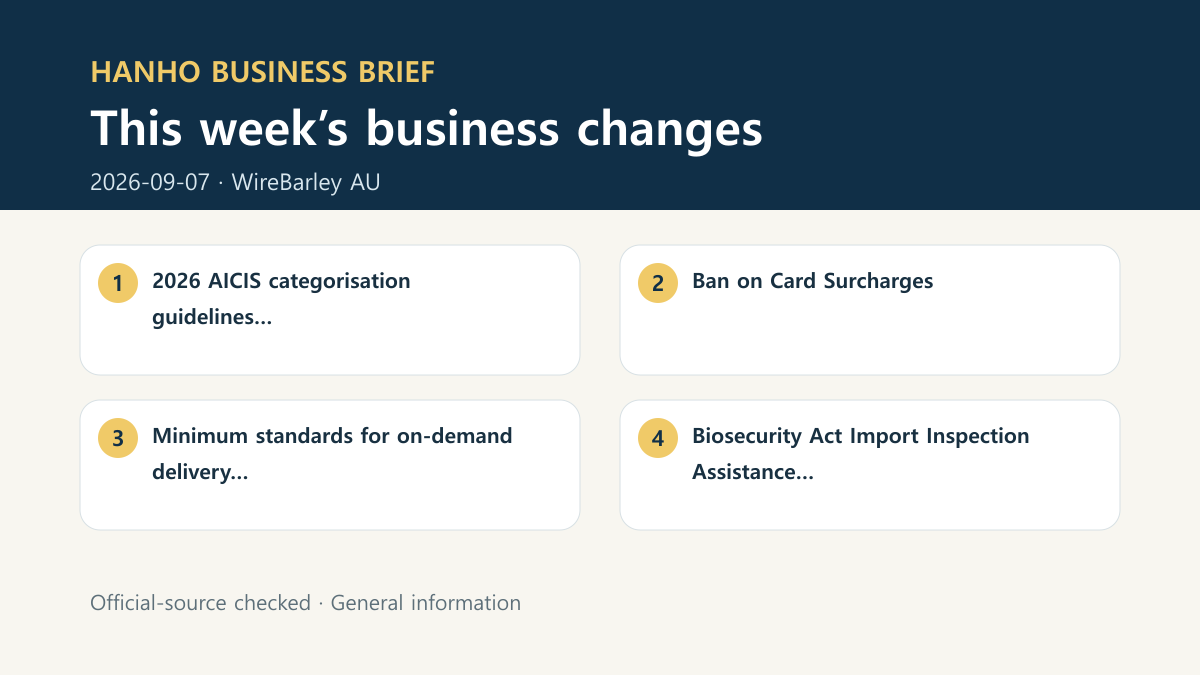
- AICIS has released the 2026 Industrial Chemicals Categorisation Guidelines and updated its categorisation guide, effective from 2026-09-01. The list of chemicals with high hazards for categorisation has 293 new entries and updates to 122 existing entries. The definition of ‘chemical identity holder’ has been unified.
- From 2026-10-01, the imposition of surcharges on all card payments, including Visa, Mastercard, eftpos, and American Express, will be completely prohibited in Australia. However, additional charges unrelated to cards, such as weekend/public holiday surcharges or booking fees, will remain. The RBA also plans to lower the interchange fee cap.
- The Fair Work Commission (FWC) has introduced the first minimum standards order for employee-like workers performing on-demand delivery work through digital labour platforms. The order includes minimum pay rates, information provision obligations, vehicle costs, record-keeping and dispute resolution conditions.
- The Department of Agriculture, Fisheries and Forestry (DAFF) has clarified the scope of industry ‘reasonable assistance’ during import cargo inspections under section 552 of the Biosecurity Act 2015, including cargo movement, unpacking and repacking. Insufficient personnel or resources may lead to inspection cancellation, cancellation fees and a requirement to reapply.
FX at a glance
- AUD/USD 0.7163 → 0.7202 · 1 week +0.54% · 1 month +2.4%
- USD/KRW 1,377.16 → 1,345.49 · 1 week -2.3% · 1 month -5.4%
- AUD/KRW 986.03 → 968.77 · 1 week -1.75% · 1 month -3.17%
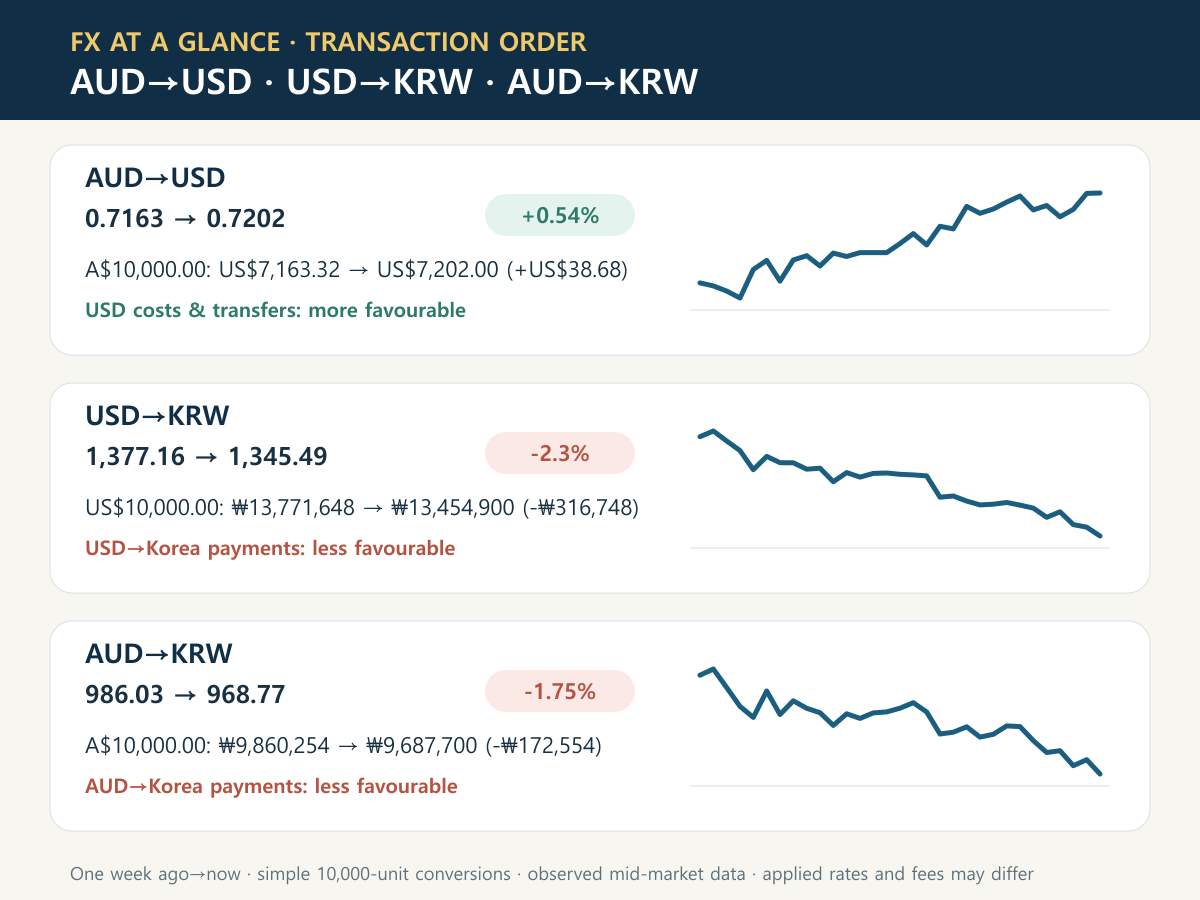
- AUD→USD: 0.7163 → 0.7202 (+0.54%). Converting A$10,000.00 would have changed from US$7,163.32 to US$7,202.00, a difference of +US$38.68. This was more favourable for Australian businesses paying or sending USD; the effect is reversed for a business converting fixed USD receipts back to AUD.
- USD→KRW: 1,377.16 → 1,345.49 (-2.3%). Converting US$10,000.00 would have changed from ₩13,771,648 to ₩13,454,900, a difference of -₩316,748. This was less favourable for businesses converting USD to KRW for Korean payments; the effect is reversed for a business converting fixed KRW receipts back to USD.
- AUD→KRW: 986.03 → 968.77 (-1.75%). Converting A$10,000.00 would have changed from ₩9,860,254 to ₩9,687,700, a difference of -₩172,554. This was less favourable for Australian businesses paying Korean suppliers in KRW; the effect is reversed for a business converting fixed KRW receipts back to AUD.
Read the Monday FX and business-payment guide →
Mid-market observations. This is not an FX forecast or a recommendation about remittance timing.
Deadlines to check (next 14 days)
- 2026-09-21 (in 14 days) · Monthly BAS — same date with or without an agent — Businesses reporting GST monthly (turnover $20 million or more, or by choice) (The 21st of the month after the period (e.g. August BAS due 21 September). ATO: the agent electronic-lodgment concession does not apply to standard monthly activity statements.) source
- Ongoing · Payday Super — super guarantee received within 7 business days of payday — All employers (from 1 July 2026) (The former quarterly SG due dates no longer apply from 1 July 2026; each payday is the trigger.) source
Based on official pages (verified 2026-09-02). Confirm your own lodgment type and any extension with your accountant.
1. 2026 AICIS categorisation guidelines update
Status: in force · Effective/deadline: 2026-09-01 · Relevant to: Businesses importing or manufacturing chemicals in Australia.
AICIS has released the 2026 Industrial Chemicals Categorisation Guidelines and updated its categorisation guide, effective from 2026-09-01. The list of chemicals with high hazards for categorisation has 293 new entries and updates to 122 existing entries. The definition of ‘chemical identity holder’ has been unified.
Business impact: For businesses importing chemicals and related finished products or raw materials into Australia from Korea or elsewhere, changes to the high-hazard chemicals list and criteria may affect introduction categories and evidence requirements.
General matter to check: Check whether imported or manufactured chemicals fall within the updated 2026 high-hazard chemicals list and hazard band C criteria using the AICIS online categorisation guide.
2. Ban on Card Surcharges
Status: announcement · Effective/deadline: 2026-10-01 · Relevant to: All businesses in Australia that accept card payments from customers and impose surcharges.
From 2026-10-01, the imposition of surcharges on all card payments, including Visa, Mastercard, eftpos, and American Express, will be completely prohibited in Australia. However, additional charges unrelated to cards, such as weekend/public holiday surcharges or booking fees, will remain. The RBA also plans to lower the interchange fee cap.
Business impact: Businesses that have passed on card payment surcharges to consumers will no longer be able to do so, potentially leading to adjustments in product pricing or increased costs. However, the reduction in the interchange fee cap may partially mitigate card processing expenses.
General matter to check: Review current surcharges applied to card payments and POS payment system settings, and consider future pricing strategies and payment gateway fee arrangements.
3. Minimum standards for on-demand delivery workers
Status: in force · Effective/deadline: 2026-08-17 · Relevant to: Employee-like workers performing on-demand delivery of food, beverages, alcohol and groceries via digital labour platform apps using vehicles with a load capacity of 1 tonne or less, and the digital platform operators engaging them.
The Fair Work Commission (FWC) has introduced the first minimum standards order for employee-like workers performing on-demand delivery work through digital labour platforms. The order includes minimum pay rates, information provision obligations, vehicle costs, record-keeping and dispute resolution conditions.
Business impact: Businesses that directly operate delivery app platforms or utilise platform-based delivery personnel may experience changes in operational methods and increased administrative costs due to compliance with minimum pay rate obligations, record-keeping, and information disclosure requirements.
General matter to check: Check whether the minimum pay rates and other mandatory conditions in the order apply to the delivery services provided or operated through digital platforms, and whether those conditions are met.
4. Biosecurity Act Import Inspection Assistance Clarification
Status: guidance · Effective/deadline: 2026-08-24 · Relevant to: Importers, customs brokers, and Approved Arrangement operators importing goods into Australia.
The Department of Agriculture, Fisheries and Forestry (DAFF) has clarified the scope of industry ‘reasonable assistance’ during import cargo inspections under section 552 of the Biosecurity Act 2015, including cargo movement, unpacking and repacking. Insufficient personnel or resources may lead to inspection cancellation, cancellation fees and a requirement to reapply.
Business impact: Increased on-site personnel costs may arise due to the requirement for businesses to allocate their own staff for cargo movement, unpacking, and repacking during physical inspections. Inspection cancellations due to inadequate assistance can lead to additional fees and customs clearance delays.
General matter to check: Check whether sufficient personnel and equipment are available on-site for cargo movement, unpacking and repacking during biosecurity inspections.
WireBarley AU update
Korean-speaking support is available for businesses checking Korean remittance or onboarding arrangements.
- WireBarley Business
- +61 1300 252 073
- WireBarley AU Kakao Channel
This brief provides general information, not individual tax, employment, legal, customs or foreign-exchange advice. Check the official source and seek appropriate professional advice. Contributors include a former CPA.