FX at a glance
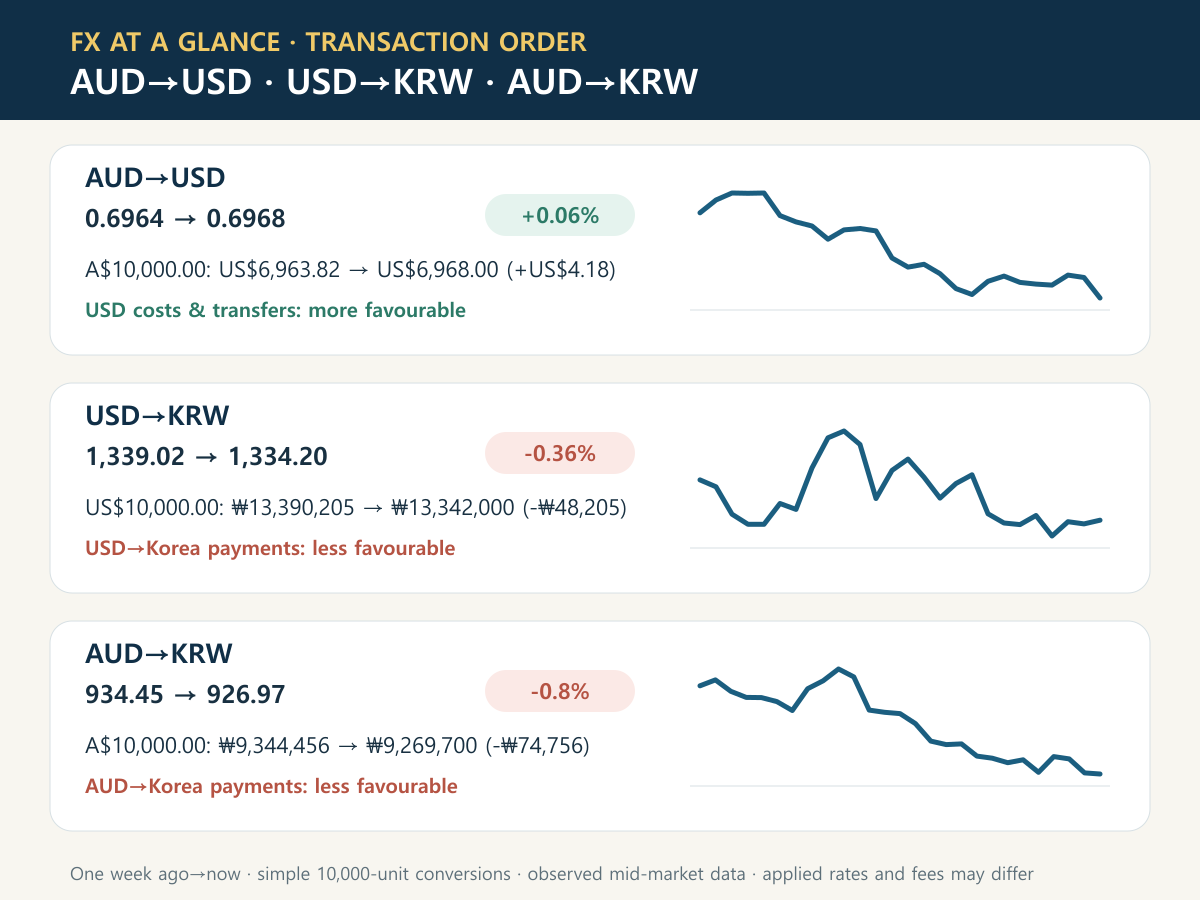
- AUD/USD: 0.6968 · vs last week 0.06%
- USD/KRW: 1334.2 · vs last week -0.36%
- AUD/KRW: 926.97 · vs last week -0.8%
A$1,000 is about ₩926,970 before fees, using observed mid-market data; actual proceeds differ.
Observed: 2026-10-18T19:06:52.177Z · Source market date: 2026-10-16
If you’ve handed a passport copy to an office while dealing with property, tax or legal matters, you now have grounds to ask how long they keep it and how they dispose of it. This issue covers that, why every RBA decision rattles household budgets here, and why a shop that stops without its owner sells for less. We picked these three mainly from last week’s most-viewed Hanho Threads posts, choosing ones that are practical for everyday Korean residents. Everything here is general information, not personal financial or legal advice.
Why every RBA decision shakes the household budget
RBA chief economist Sarah Hunter, born in the UK and now an Australian citizen, was asked on a podcast what struck her as quirky about Australia. Her answer: how much everyone talks about housing. She had never seen auction clearance rates reported on a Monday morning before.
ABC News analysis argues it isn’t just a national hobby. The competition regulator describes retail banking here as an oligopoly, and banks mostly offer short-term variable-rate home loans. So when the RBA moves rates, millions of mortgage households can see their monthly budget change by hundreds of dollars. In countries where 20- and 30-year fixed-rate loans are common, households barely notice their central bank’s moves.
One thing you can check yourself: if rates change at the next RBA meeting, put your lender’s repayment change notice next to the article’s ‘hundreds of dollars a month’. The same notice or your loan contract will also show whether your loan is variable or fixed, and if fixed, when that period ends.
The ID copy you gave that office: you can now ask
Have you handed over a passport or licence copy when using a real estate agent, accountant, lawyer or conveyancer?
According to a contributed piece in Inside Small Business, businesses in these sectors took on new customer identification duties this year as Tranche 2 entities under the anti-money laundering (AML/CTF) laws. Small businesses with annual turnover under $3 million were previously exempt from the Privacy Act, but the article says guidance issued this year by the privacy regulator (OAIC) means these reporting entities must now comply regardless of turnover. That covers storing ID data securely, disposing of it once it’s no longer needed, and checking how third-party vendors, including overseas ones, handle it.
As a customer, you can ask two questions when you hand over documents: ‘How long will you keep this copy, and how will you dispose of it?’ and ‘Is it shared with any outside vendors?’
This is based on one legal industry expert’s article. Confirm how it applies to your own situation with the OAIC or a qualified adviser.
The shop that runs without you is worth more
‘Nobody else can do what I do.’ Small-business coach Gabe Enslin, co-founder of Adapt, says it’s the answer he hears most from owners. He thinks they’re usually right, and that this is exactly the problem.
He cites a William Buck survey in which 40 per cent of Australian owners described their business as heavily reliant on them. John Warrillow’s Value Builder research found businesses that could run without the owner sold for around 4.5 times pre-tax profit, while those where the owner knew every customer personally sold for under three times. Same profit, very different price.
Enslin argues that building a team of leaders, mostly grown from inside, works better than hiring one general manager. His starting points: pick at least two of the roles you carry, hand them over with real decision rights, and watch for three months without stepping in. Write down one decision a week, such as how you price or how you hire. He expects the whole process to take two or three years.
If you run a shop, start by asking how many days it could run without you.
One insight from WBAU transfer data
How often did customers transfer in active months?
74.5% of 638 active customer-months had 1–3 transfers. Months with no transfers are excluded from the denominator.
- 1–3 transfers in an active month: 74.5% (475 customer-months)
- 4+ transfers in an active month: 25.5% (163 customer-months)
Consider payment dates and AUD cash outflows across an active month, not just one payment. This is not an all-customer monthly average or a recommended frequency.
Basis: 2025-09-01~2026-08-31 · Internal WBAU AU→KR B2B transfers sent in AUD, with paid/approved status, deduplicated by transfer number. Not representative of all Korean businesses in Australia; customer nationality is not classified. No customer identities or individual transactions are disclosed.
More economic and everyday-life stories
General information, not individual advice. You may unsubscribe at any time using the footer link.