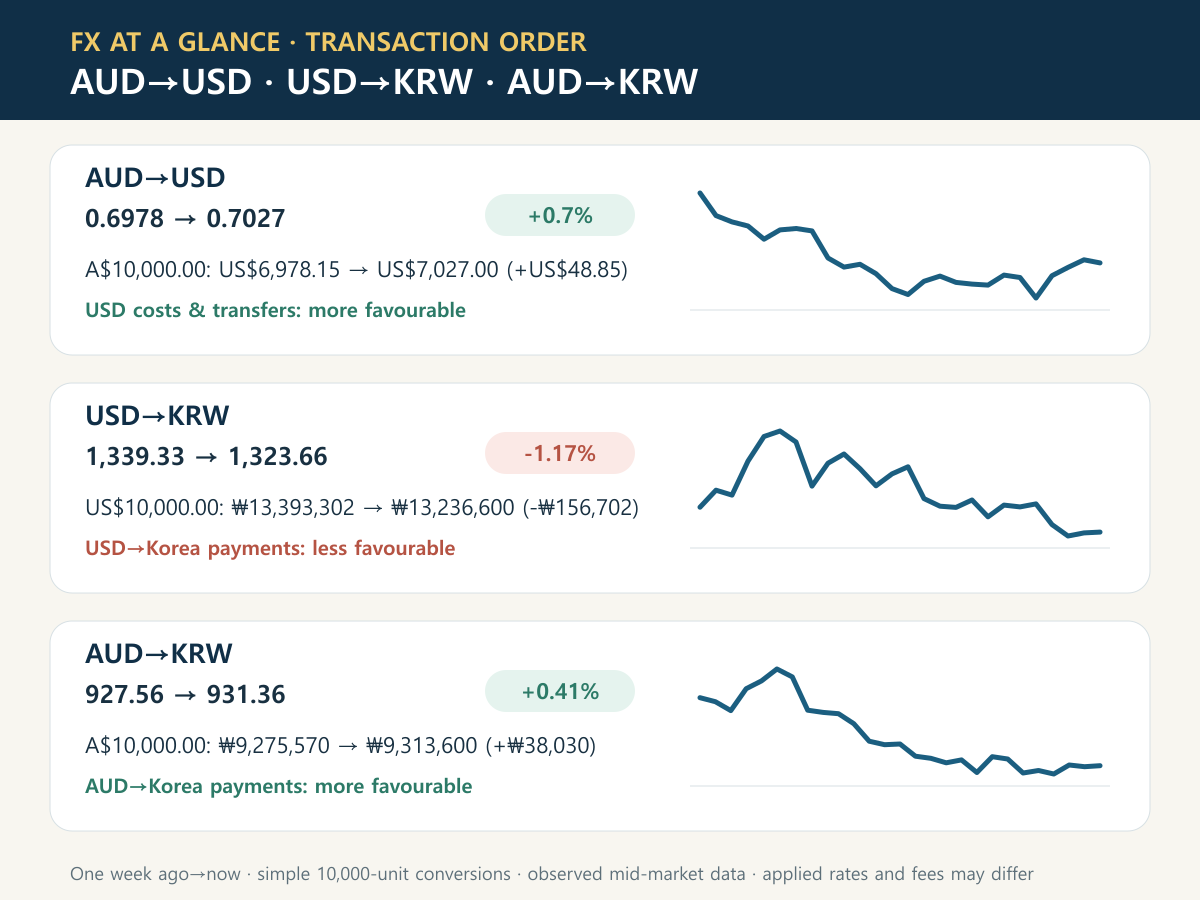
FX at a glance
- AUD/USD: 0.7027 · vs last week 0.7%
- USD/KRW: 1323.66 · vs last week -1.17%
- AUD/KRW: 931.36 · vs last week 0.41%
A$1,000 is about ₩931,360 before fees, using observed mid-market data; actual proceeds differ.
Observed: 2026-10-25T19:05:53.581Z · Source market date: 2026-10-23
Hello and welcome to the Hanho Business Brief. This week we have picked stories from last week’s Threads posts that drew the most interest, along with stories that touch everyday costs and safety. The most-read post was about the cost of getting to the new Western Sydney airport (1,456 views), followed by the change in repayments for Suncorp home loan customers (600 views). We have added what the card surcharge ban could mean for prices, scam calls posing as police, and a record year for financial complaints. In my view, this week’s stories share one thread: what you actually end up paying, and how you check, matters more than the price tag or the number on your screen. Each story ends with a short question, so feel free to reply.
New airport fares: first work out the cost of getting there
If you are eyeing a cheap family holiday fare out of Western Sydney International Airport, it is worth checking one more thing before you book on the ticket price alone.
ABC News reported that Western Sydney International Airport (WSI) is 45 kilometres from the Sydney CBD and 18 kilometres from the Penrith city centre, and runs around the clock, with commercial flights starting on 25 October. The Metro line is due for completion in 2027, so until then trains do not go to the airport. A free shuttle bus runs every 30 minutes from St Marys station. From Central, a train then a bus from Penrith takes about 1 hour 40 minutes and costs $10.31. Buses through Mount Druitt, Penrith, Liverpool, Campbelltown and Leppington start from a $5.77 adult peak fare. The express shuttle from the Sydney CBD costs $55 one way or $80 return, and from Parramatta $25 one way or $45 return. Drivers can use the toll-free M12 motorway. Parking is free for three hours, then $15 a day for long-stay, $29 a day for uncovered bays and $49 a day for covered. A taxi from the airport to Penrith was estimated at about $81, and a rideshare at about $60. Qantas, Jetstar, Air New Zealand, Singapore Airlines, VietJet and Fiji Airways have announced routes from the airport.
Here is what you can check yourself. Put your home address into the Transport NSW trip planner for travel time and fares, multiply the return trip or parking by the size of your family, and compare that with the fare difference. In my view, in the early months it will often be the door-to-door cost that decides which airport makes sense.
Which is closer to your home: Kingsford Smith or Western Sydney?
Extra money in a Suncorp home loan? Check your email
If you have a Suncorp home loan and have kept your monthly repayments low by keeping spare money in redraw or cashback, this story may apply directly to you.
ABC News reported that ANZ, which bought Suncorp in 2024, is moving Suncorp borrowers onto ANZ loan platforms, and more than a million Suncorp customers are set to move to ANZ by 2027. On 13 October Suncorp emailed customers saying that if they had made advance payments, their minimum repayment at ANZ was likely to increase. One customer said the email indicated repayments could rise by more than $1,000 a month. Suncorp allowed customers with redraw and cashback facilities to reduce their minimum repayments, but ANZ does not have this policy. In the article’s example, with $600,000 owing, 25 years remaining, $100,000 extra sitting in the loan and the average owner-occupier variable rate of 6.49 per cent, the minimum monthly repayment comes to either $4,047 or $3,373 depending on the method. Suncorp said most customers would see no change, and those ahead on repayments could avoid an increase by taking action.
Here is what you can check yourself. Search for an email from Suncorp from around 13 October, including your spam folder, and note what action it asks for and by when. You can also ask the bank whether your redraw balance is currently being counted in your repayment calculation. In my view, when your bank changes, how repayments are calculated matters as much as the interest rate.
Do you usually read bank merger or transfer emails all the way through?
Source · Threads · Housing, rates & cost-of-living guide →
Will the card surcharge ban push up the price of coffee?
If you welcomed the news that the extra fee on card payments at your local cafe is going away, it is worth asking where that cost ends up.
Inside Small Business reported on a survey by small-business lender OnDeck Australia of 253 small businesses in retail, hospitality, ecommerce and services. Sixty-six per cent expect the changes to increase their costs, and 23 per cent expect the increase to be significant. Forty-four per cent plan to raise prices to cover the extra expense, while 23 per cent plan to absorb it and 17 per cent intend to steer customers towards lower-cost payment methods. In hospitality, 69 per cent expect costs to rise and 51 per cent plan to raise prices. The article says the projected $1.6 billion in surcharge savings could be wiped out by higher prices. Separately, the ATO had said it would stop accepting credit card payments after 30 November 2026, but after Treasurer Jim Chalmers stepped in on 9 October it will keep accepting them until 30 June 2027. The article does not say exactly when the surcharge ban takes effect.
Here is what you can check yourself. Note the menu prices at the cafes and restaurants you visit often, and compare them after surcharges go. If you run a business, check whether you pay tax to the ATO by credit card and plan how you will pay after 30 June 2027. In my view, the fee is less likely to disappear than to move into the price tag.
Would you be fine with a slightly higher price at your regular spot if the surcharge disappeared?
Source · Threads · FX & remittance guide →
A ‘police’ call from an Australian number? Hang up and check
If an ordinary-looking Australian number calls and the person says they are from the Federal Police and asks you to come to a police station, it is easy to feel nervous, especially if phone calls in English still feel unfamiliar.
ABC News reported that TPG, the owner of Vodafone, analysed millions of scam calls on its network between July 2025 and July 2026 and found 98 per cent, more than 24 million calls, came via Symbio, an internet phone wholesaler owned by Aussie Broadband. Symbio sells Australian phone numbers in bulk to companies so they can make calls over the internet. The report describes calls impersonating the AFP and police stations in Western Australia, Queensland and South Australia, with more than 2,400 calls in a single week in September. When the Scams Prevention Framework is fully introduced next year, telcos will face stricter obligations, and those that fail could face penalties of up to $11 million. The ACMA said telcos had reported blocking more than 3.12 billion scam calls since December 2020.
Here is what you can check yourself. If a caller claims to be from an agency, hang up, look up that agency’s official number yourself and call back. Checking with a number the caller emailed or texted you is not a real check. In my view, a number that looks genuine no longer proves anything.
Have you or someone in your family ever had a call from someone claiming to be police or a government agency?
A charge you don’t recognise? There is a step after the bank
If you have spotted a charge on your card statement that you do not remember, and have been putting off calling the bank because explaining it in English feels like a hassle, it helps to know a lot of people went through the same thing last year.
SBS Korean reported that the Australian Financial Complaints Authority (AFCA) received about 120,000 financial complaints in the 2025-26 financial year, up 19 per cent on the year before and a record high. Complaints about scams and unauthorised transactions rose sharply.
Here is what you can check yourself. Look over your card statements regularly, and if you see a charge you do not recognise, tell your bank the same day. If the bank does not resolve it, remember that AFCA is the next place to go. In my view, where Korean residents most easily lose out is not the loss itself but delaying the report because explaining it in English feels like a burden. Getting worn out at the bank counter does not have to be the end of it.
Do you know anyone who just let an unfamiliar charge go?
Source · Threads · Tax & running-a-business guide →
One insight from WBAU transfer data
Korea-bound business transfers: 43.2% in USD
43.2% of 2,037 Korea-bound business transfers were received in USD. This is a share of transaction counts, not value.
- Received in USD: 43.2% (881 transfers)
- Received in KRW: 56.8% (1,156 transfers)
A Korean counterparty does not necessarily receive KRW. Checking invoice and receipt currencies helps distinguish AUD/USD from AUD/KRW exposure. This aggregate does not establish why USD was chosen or which currency is better.
Basis: 2025-09-01~2026-08-31 · Internal WBAU AU→KR B2B transfers sent in AUD, with paid/approved status, deduplicated by transfer number. Not representative of all Korean businesses in Australia; customer nationality is not classified. No customer identities or individual transactions are disclosed.
More economic and everyday-life stories
General information, not individual advice. You may unsubscribe at any time using the footer link.