The one-minute answer
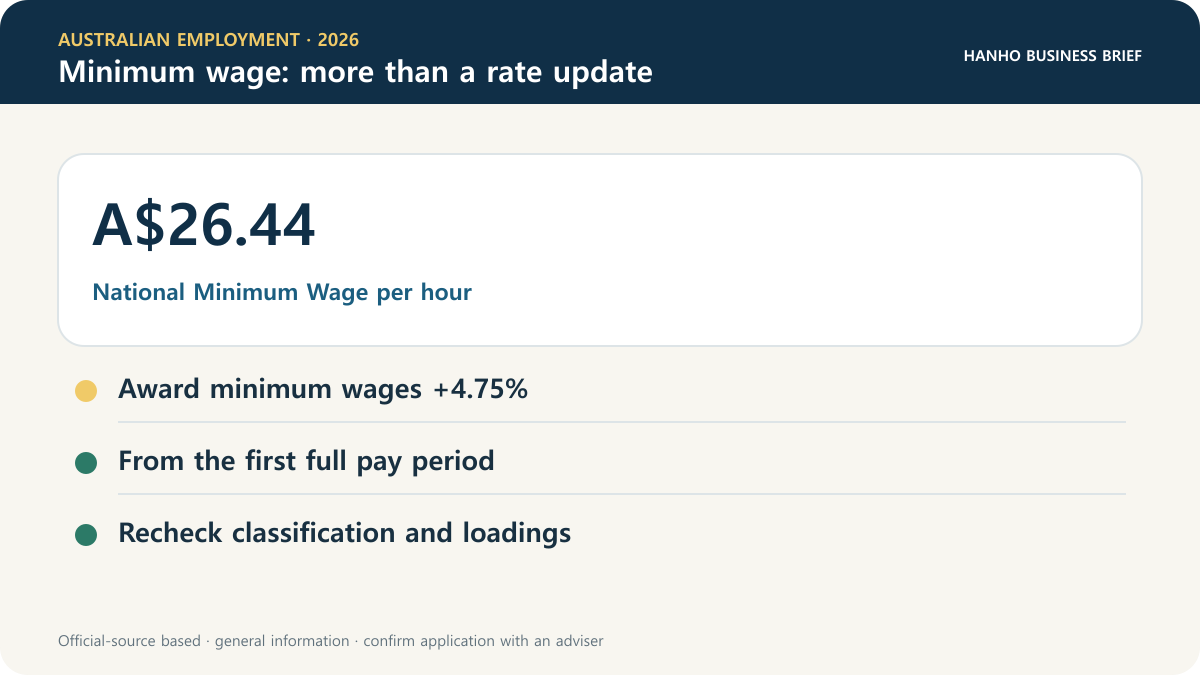
From the first full pay period starting on or after 1 July 2026, the National Minimum Wage is A$1,004.90 for a 38-hour week or A$26.44 an hour. A casual employee entitled to the National Minimum Wage must receive at least A$33.05 an hour, including the 25% casual loading. Award minimum wages rose by 4.75%, but the actual rate depends on the employee’s award, classification and duties.
Is changing the base rate enough?
Not necessarily. The base rate can flow through to weekend, public-holiday and evening penalties, overtime, allowances, casual loading and the earnings base used for super. If an employee’s duties have changed but their classification has not, importing the latest pay table can still produce the wrong result.
| Review area | Common blind spot |
|---|---|
| Applicable award | Check coverage and actual duties rather than relying only on the industry label. |
| Classification | Confirm responsibility, skill and supervision still match the recorded level. |
| Effective pay period | Apply the change from the first full pay period starting on or after 1 July. |
| Related pay items | Recheck penalties, overtime, allowances and loading against the new base. |
Potential impact on Korean-Australian SMEs
Hospitality, retail and logistics businesses with variable rosters may see discrepancies accumulate through weekend, evening and overtime calculations rather than the ordinary weekday rate. Even for a small team, modest differences across several pay periods can become a material remediation exercise. The higher labour cost is also a reason to revisit roster design, opening hours and product-level margins.
From a former CPA’s perspective, payroll accuracy and business profitability begin with the same data. Accurate classifications and hours support correct pay, but they also make labour-cost reporting by shift or product more reliable. Updating payroll without updating the operating budget can delay visibility of the true margin impact.
General matters to check
- Whether each employee’s award and classification match their current duties
- Whether the new rate applied from the correct first full pay period
- Whether weekend, public-holiday, evening and overtime tables were updated
- Whether casual loading, allowances and super calculations remain connected correctly
- Whether payslips and timesheets use the same underlying hours
- Whether the revised labour cost is reflected in the next 8–12 weeks of cash-flow and margin planning
A practical sample check
Rather than reviewing every pay line by eye, test several contrasting cases after the update: a permanent weekday employee, a weekend casual and an employee with overtime. Checking the base rate, loading and penalty result in each case can expose configuration errors early.
Awards and employee entitlements depend on the facts. Use Fair Work’s current Pay and Conditions Tool and seek appropriate advice for the specific workplace.
Return to Business Brief Issue 1 · Has the wage increase flowed into your product or service margins as well as payroll?