This edition in 30 seconds
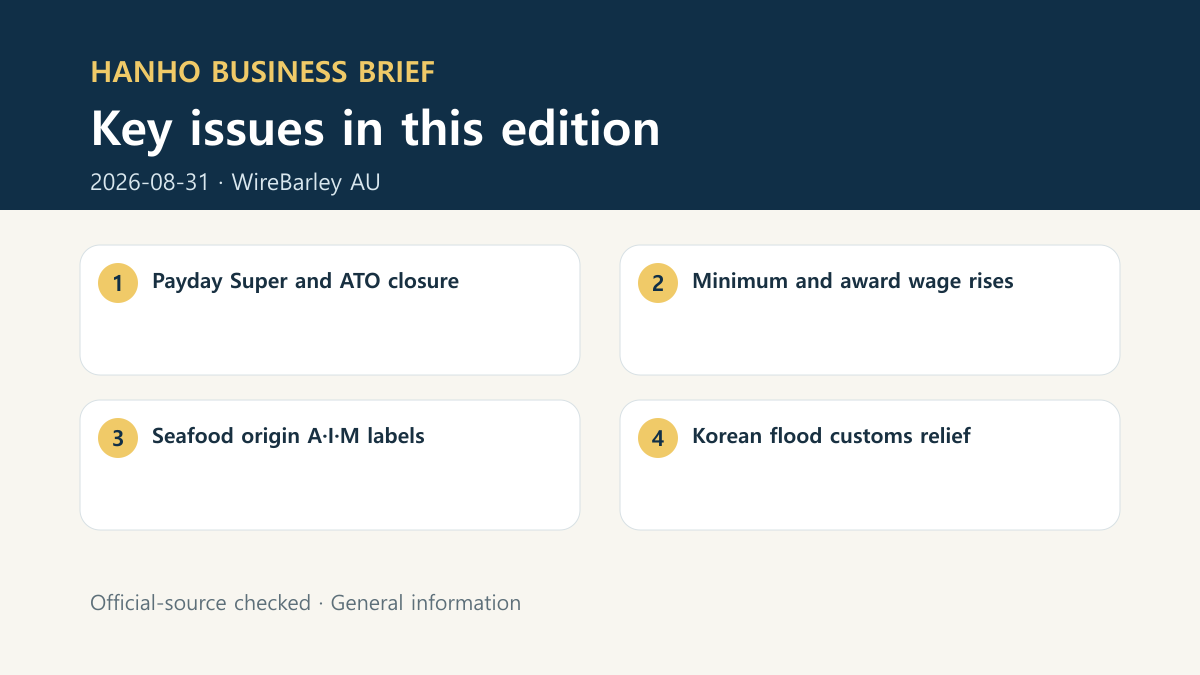
- Since 1 July, employers have had to calculate and pay the 12% super guarantee on each payday under Payday Super. The ATO’s Small Business Superannuation Clearing House has also closed.
- The National Minimum Wage is now A$26.44 an hour or A$1,004.90 a week, and award minimum wages have risen by 4.75%.
- Hospitality businesses serving seafood must show its origin before customers order using Australian (A), Imported (I) or Mixed (M) labels.
- Korean flood-affected importers and exporters may be eligible for customs payment extensions, instalments and expedited clearance of urgent materials.
Detailed guides from this issue
Use the weekly brief to scan the changes, then open the standalone guides for the operational detail and general matters to check.
- Payday Super employer checklist
- Australia’s 2026 minimum wage: employer payroll checklist
- Seafood origin A, I and M labelling guide
- Korean flood customs relief: Australian trader guide
FX at a glance
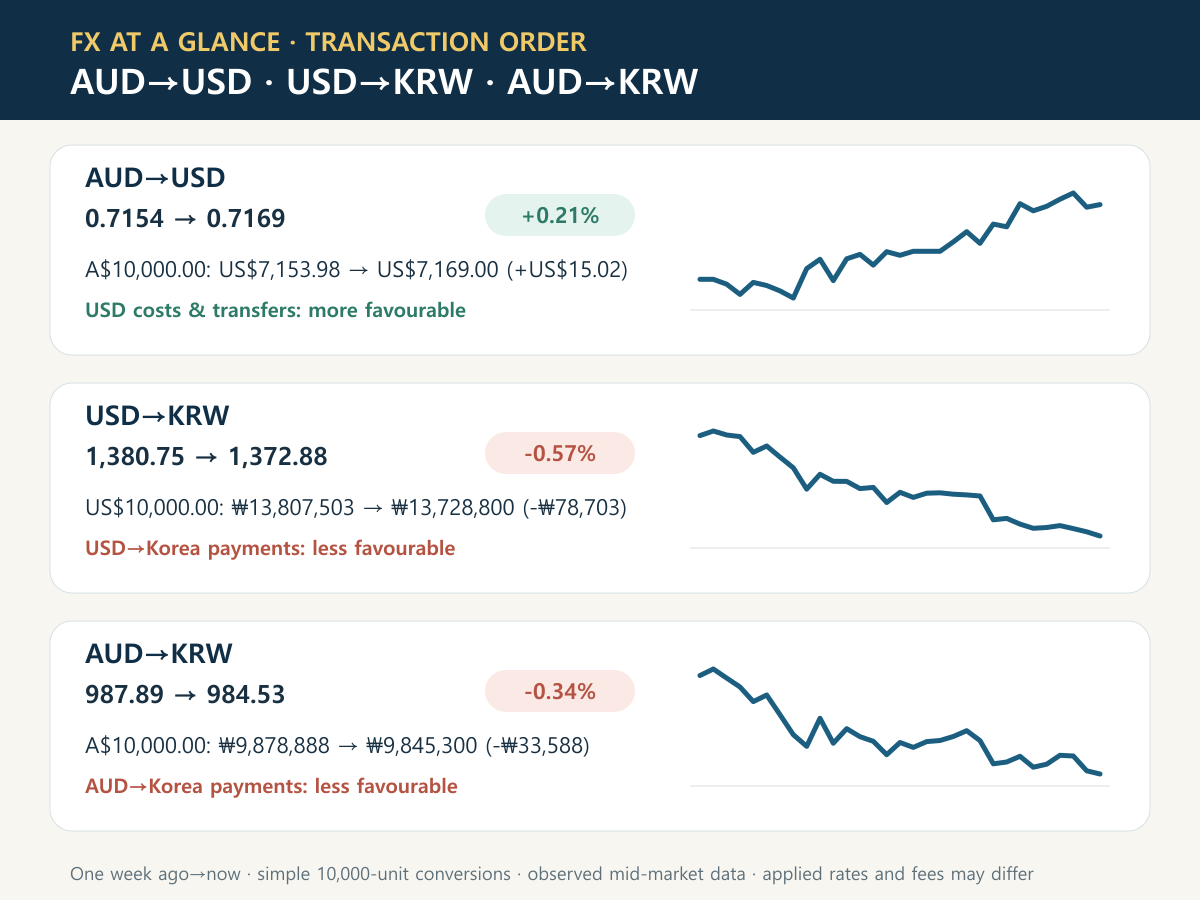
- AUD/USD 0.7154 → 0.7169 · 1 week +0.21% · 1 month +1.75%
- USD/KRW 1,380.75 → 1,372.88 · 1 week -0.57% · 1 month -4.38%
- AUD/KRW 987.89 → 984.53 · 1 week -0.34% · 1 month -2.69%
Who benefited, and by how much
- AUD→USD: 0.7154 → 0.7169 (+0.21%). Converting A$10,000.00 would have changed from US$7,153.98 to US$7,169.00, a difference of +US$15.02. This was more favourable for Australian businesses paying or sending USD; the effect is reversed for a business converting fixed USD receipts back to AUD.
- USD→KRW: 1,380.75 → 1,372.88 (-0.57%). Converting US$10,000.00 would have changed from ₩13,807,503 to ₩13,728,800, a difference of -₩78,703. This was less favourable for businesses converting USD to KRW for Korean payments; the effect is reversed for a business converting fixed KRW receipts back to USD.
- AUD→KRW: 987.89 → 984.53 (-0.34%). Converting A$10,000.00 would have changed from ₩9,878,888 to ₩9,845,300, a difference of -₩33,588. This was less favourable for Australian businesses paying Korean suppliers in KRW; the effect is reversed for a business converting fixed KRW receipts back to AUD.
Read the Monday FX and business-payment guide →
Observed 1 September 2026 at 02:57 pm AEST using mid-market data. Applied rates, fees and recipient amounts can differ. This is not an FX forecast or a recommendation about remittance timing.
1. Payday Super and the closure of the small-business clearing house
Status: in force · Effective: 1 July 2026 · Relevant to: Australian employers
Employers now calculate the 12% super guarantee on qualifying earnings each payday and generally need contributions to reach the employee’s fund within seven business days. The ATO’s small-business clearing house also closed on the same date. Super cash flow and exception handling now follow the pay cycle, making payroll, STP, SuperStream and returned contributions one operating process.
Read the detailed Payday Super guide →
2. National and award minimum wages have increased
Status: in force · Effective: first full pay period starting on or after 1 July 2026 · Relevant to: Australian employers
The National Minimum Wage is A$26.44 an hour or A$1,004.90 a week, while award minimum wages rose by 4.75%. Actual rates depend on the applicable award and classification. Updating only the base rate can leave penalties, overtime, allowances, casual loading or super settings out of step and allow discrepancies to accumulate.
Read the 2026 minimum-wage employer guide →
3. A, I and M seafood-origin labels are now mandatory
Status: in force · Effective: 1 July 2026 · Relevant to: hospitality businesses serving seafood for immediate consumption
Hospitality businesses must show whether seafood is Australian, Imported or Mixed before customers order and explain the A, I and M abbreviations. Supplier evidence needs to remain available for three months after the product stops being sold. Printed, QR, web and delivery menus therefore need to stay connected to procurement changes.
Read the detailed A, I and M labelling guide →
4. Korean customs relief for flood-affected importers and exporters
Status: implementation guidance · Announced: 20 August 2026 · Relevant to: importers and exporters affected by flooding in Geoje and Tongyeong
The Korea Customs Service announced potential support covering customs payment and instalments, audit and FTA origin-verification timing, urgent clearance and export loading periods. Relief should not be assumed to be automatic. Australian counterparties should confirm the Korean business’s application and approval status, then align revised shipment dates across settlement, inventory and logistics documents.
Read the Korean customs-relief trade guide →
Korea trade checklist
- Currency and settlement date for KRW and USD invoices due this week
- Changes to the Korean counterparty’s shipment or customs timetable and supporting documents
- Current minimum-wage, award-rate and Payday Super settings in Australian payroll
WireBarley AU update
Korean-speaking business support is available for businesses checking Korean remittance or onboarding arrangements.
- WireBarley Business service and onboarding
- Customer service: +61 1300 252 073
- WireBarley AU Kakao Channel
This brief provides general information, not individual tax, employment, legal, customs or foreign-exchange advice. Check the official source and seek appropriate professional advice for your circumstances. Contributors include a former CPA.