The one-minute answer
On 20 August 2026, the Korea Customs Service announced customs-payment, audit and FTA origin-verification, urgent-clearance and export-loading support for importers and exporters affected by flooding in Geoje and Tongyeong. The measures do not apply directly to an Australian business, but they may change a Korean counterparty’s settlement, document and shipment timetable.
What support was announced?
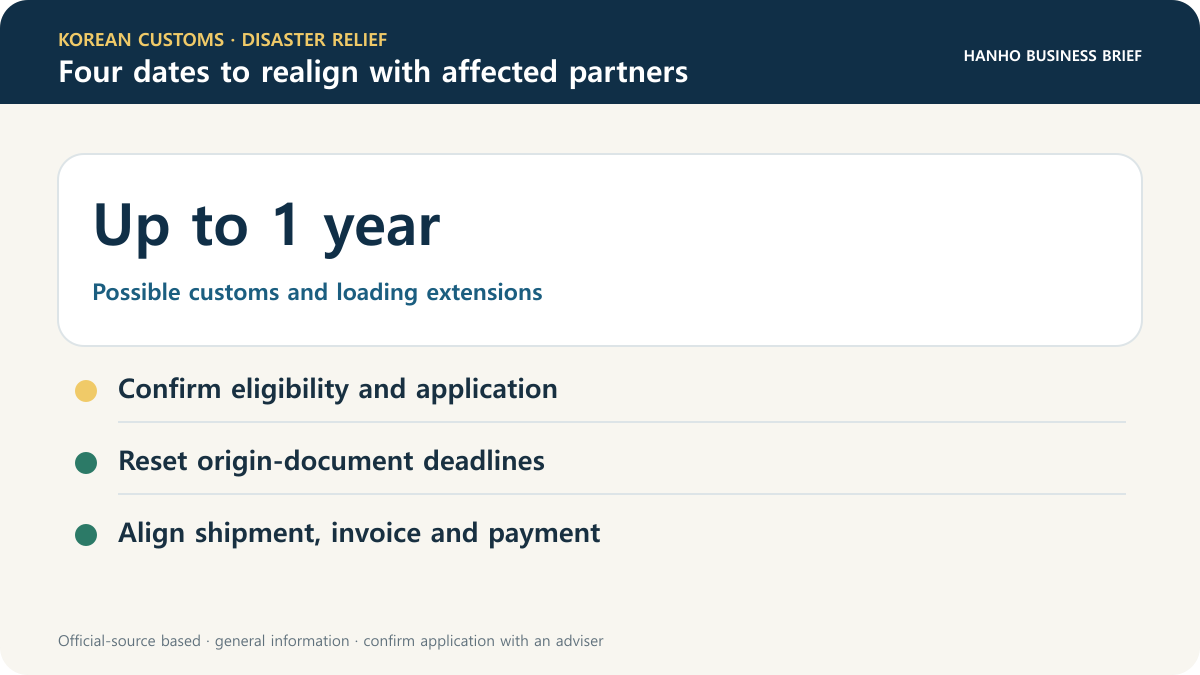
The announcement includes extensions of up to one year or instalment arrangements for customs and related taxes, with security waived. Customs audits are generally to be deferred until year-end. FTA origin verification may be held where it has not started, while an application to defer an existing verification will be considered.
The measures also cover expedited clearance for urgently sourced materials. If flood damage makes shipment difficult, the loading period for export goods may be extended from the ordinary 30 days to within a maximum one-year period if approved. Eligibility, evidence and the relevant customs-office process need to be confirmed rather than treated as automatic.
| Korean counterparty check | Connected Australian check |
|---|---|
| Eligibility and damage evidence | Contract notice and any force-majeure process |
| Customs extension or instalments | Settlement date and possible supply-price effects |
| FTA origin-verification timing | Origin-document deadline and import preparation |
| Approved shipment extension | Freight booking, inventory and customer delivery dates |
Potential impact on Korean-Australian SMEs
Even where a Korean supplier receives relief, the Australian purchase order and freight booking do not change automatically. A later dispatch date can affect inventory coverage, customer commitments, payment terms and the period of foreign-exchange exposure. Expedited inputs may also help the supplier restore production sooner than first expected, so confirmed dates matter more than assumptions.
From a former CPA’s perspective, the important control is to reflect an approved revised date consistently across systems and documents. Sales may know the new delivery date while accounts still holds the old payment date or the freight forwarder still works to the previous shipment plan. Those mismatches make cash-flow forecasting and customer communication less reliable.
General matters to check
- Whether the Korean counterparty falls within the official affected-business scope
- Which customs office is handling the application and what evidence was submitted
- Whether relief is proposed, applied for or approved, and for what period
- How shipment, settlement and FTA origin-document dates will change
- Whether revised dates appear in purchase orders, invoices, freight bookings and customer commitments
- How the new timetable changes inventory risk and the duration of FX exposure
Four questions for the counterparty
- Which customs office has confirmed the damage and potential eligibility?
- What production, clearance and shipment dates are currently confirmed?
- Will the origin certificate or invoice timetable change?
- Does the Australian side need to amend any contract or logistics document?
This article connects the Korean customs announcement with general Australian trade operations. Confirm individual eligibility and approvals with the Korean counterparty and relevant customs office.
Return to Business Brief Issue 1 · Are the counterparty’s revised shipment date, settlement date and inventory plan aligned?