The one-minute answer
Payday Super has been in force since 1 July 2026. Employers calculate the 12% super guarantee on qualifying earnings each time salary or wages are paid. Contributions generally need to reach the employee’s super fund within seven business days of payday, so checking the payment instruction alone is not the end of the process.
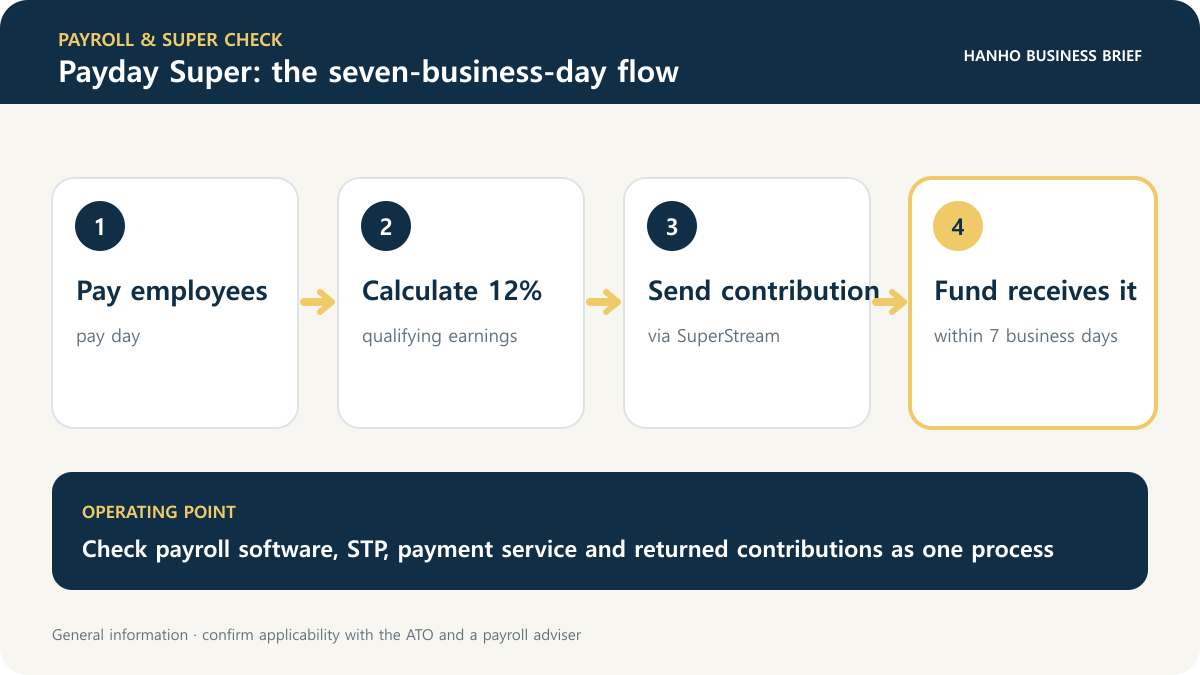
What changed?
Many small employers previously concentrated super payments around quarterly deadlines. Super cash flow now follows the actual weekly, fortnightly or monthly pay cycle. The ATO’s Small Business Superannuation Clearing House also permanently closed on 1 July, so former users need another SuperStream payment route and their own accessible contribution records.
| Control point | Operational meaning |
|---|---|
| Calculation each payday | Qualifying earnings and the 12% calculation need to connect to payroll data. |
| Receipt within seven business days | Track receipt by the fund, not only the date payment was initiated. |
| Returned contributions | Someone needs to correct member or fund details quickly. |
| Clearing house closure | Confirm the replacement payment route and location of historical records. |
Potential impact on Korean-Australian SMEs
The main changes are the frequency of cash outflow and the time available to fix exceptions. Super funds are needed at each pay run rather than once near quarter-end. Even when payroll calculates the amount correctly, an error in the payment service or employee fund data can leave the contribution incomplete.
From a former CPA’s perspective, this is less like changing a tax rate and more like changing the payroll close. If the payroll operator, bookkeeper and owner look at different systems, a gap can open between “payment processed” and “received by the fund”. A short exception reconciliation after every pay run can make that gap visible.
General matters to check
- Whether payroll software supports Payday Super and qualifying-earnings reporting
- Which SuperStream payment route replaced the former ATO clearing house
- Whether employee fund, member and USI information is current
- Who monitors and corrects returned or unallocated contributions, and when
- How payday, payment initiation and fund receipt are evidenced
- Whether more frequent super outflows are reflected in short-term cash-flow planning
A simple operating rhythm for a small employer
- Check employee data and qualifying-earnings settings before payroll is finalised.
- Confirm STP and the super payment file draw from the same payroll data on payday.
- Review returned or unallocated items promptly after payment.
- Carry unresolved exceptions and the next super cash requirement into the next payroll review.
Payroll structures and applicable rules vary. Confirm the position through the ATO’s current guidance and appropriate professional advice.
Return to Business Brief Issue 1 · In your payroll process, who checks what happens after a contribution is submitted?