The one-minute answer
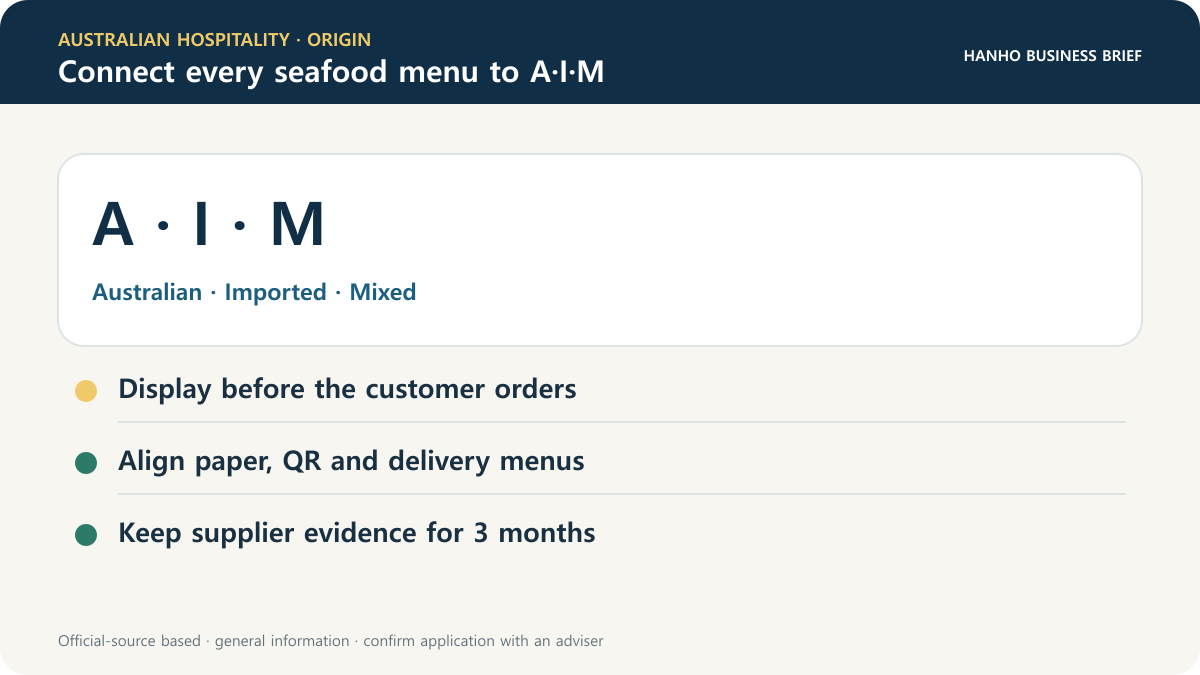
Since 1 July 2026, restaurants, cafés, pubs, takeaways, online ordering and delivery services, food trucks and other hospitality businesses serving seafood for immediate consumption must show whether it is Australian, Imported or Mixed before the customer orders. If the abbreviations A, I and M are used, a visible legend needs to explain them.
Where should the label appear?
The practical test is whether the customer can see the origin before making the order. Updating a printed menu while leaving QR menus, kiosks, the business website or delivery platforms unchanged can create conflicting information across channels. Mixed seafood dishes and products whose supply origin varies need to be checked against the government’s current labelling guidance.
| Sales channel | General location to review |
|---|---|
| Dine-in | Printed menu, menu board or other pre-order display |
| QR menu or kiosk | Item description or a legend visible before ordering |
| Website or delivery app | Menu screen shown before checkout |
| Telephone order | Internal item list that staff can explain consistently |
What evidence should be retained?
Written supplier evidence—such as an invoice, statement or origin declaration—should identify the origin of the relevant product. Official guidance says this evidence needs to be retained for three months after the business stops selling the product. Origin is based on where the seafood was harvested, not where it was processed, so a statement such as “processed in Korea” does not by itself establish the required origin label.
If a supplier changes, or the origin of the same supplied product changes, the menu and internal product record may also need to change. A blanket M label should not be used merely for convenience without a proper basis under the guidance.
Potential impact on Korean-Australian SMEs
Korean and Japanese restaurants often use several seafood inputs in dishes such as fish cake, squid, prawns or sashimi. An A, I or M label can also disappear when menu content is translated or copied across platforms. If procurement knows the origin but the menu manager does not, a supplier change can leave the public label behind.
From a former CPA’s perspective, this is not only a menu-design task; it is a product-master-data task. Recording supplier, origin, evidence date and menu status against each product code can connect compliance, food cost and evidence retention. Changes in origin can also coincide with changes in price and margin, making the quality of procurement data important.
General matters to check
- Whether every seafood item shows A, I or M, with a legend, before ordering
- Whether printed, web, QR, kiosk and delivery menus show the same information
- Whether suppliers provide written origin evidence by product
- Whether evidence remains retrievable for three months after the product stops being sold
- Whether supplier or origin changes trigger a menu update
- Whether mixed and seasonal dishes have been checked against official guidance
A simple menu audit
List seafood items by row and record the sales channel, current supplier, origin, evidence location and last review date in columns. Making that register part of new-supplier setup can reduce the lag between a procurement change and the customer-facing menu.
The correct treatment can depend on product composition and sales method. Check the Australian Government’s current guidance and seek appropriate advice where required.
Return to Business Brief Issue 1 · When a supplier changes, who updates your delivery-platform menu?